
by Ray Ingaglio

Training
I lost all of December and the first half of January to leftover knocks/issues from my Nov 20th Philly Marathon, which was my first one ever.
I started the training block weighing 174 pounds, which I was not particularly happy with. I didn’t subscribe to a specific training plan, but I was training for a sub 1:45 finish. I ran the Reading Hospital Road Run last October in 1:59:12. I used a loose plan of only adding about 10% mileage per week: Tuesday speed day; Thursday recovery pace; Friday steady; and Sunday long run. I was basically mimicking the marathon plan I used with some minor adjustments. I scaled up my long runs and maxed out at 12- and 14-milers the last month of the block. I started at 20 miles a week, and peaked at 31 miles for 2 out of the last 3 weeks. I also lifted legs one day a week (Wednesdays).
Before carb loading, I was weighing 156 (18 lbs lost) from a consistent 500 calorie a day deficit. When I say consistent, I mean from Jan 14th to May 4th, I tracked every single calorie that went into my body and from experience, was eating back calories based on calorie expenditure from lifting (200-300 cal per session) and running (100 cal per mile ran). In that span, I had 2 cheat days, zero alcohol, and consistently slept 7-8 hours a night by going to bed at 9:30 to wake up around 5:15 a.m. Personally I function best off of strict routines.
I carb-loaded according to the free calculator by Featherstone Nutrition again. 600g a day for 2 days leading up to the race. I know that there are conflicting thoughts on carb-loading for a half, but knowing I was generally training on minimal fuel, I felt that a full load was going to be a difference-maker for me.
Saturday morning, I woke up with a sore knee, which mentally threw me off big time. I tried to calm myself down, but I was extremely worried this was going to derail a race that I had put so much effort into. I jogged 2-3 times throughout the day for about 100 feet to test it out, but I was not fully confident that I was going to be 100% for the race.
Pre-race
Pittsburgh’s race organization was 10/10. I will recommend this race weekend to ANYBODY who asks me, and I likely will proactively encourage others to do it.
After my race in Philly, which included 30 minutes in a security line, 30 minutes for porta-potty and gear check, all before I even started my warm up, I was shocked by how nicely Pittsburgh’s pre-race panned out.
I stayed at the Wyndham Downtown, which was literally right outside the gear check and post-race festivities at Point State Park. I left my room at 6 a.m. for the 7 a.m. start, hoping that it wasn’t going to be a debacle like Philly. The combo of zero security delays and a smooth gear check meant I was actually sitting around chatting with other runners for 20 minutes before I started to warm up. I felt way less stressed and anxious.
race
Race strategy coming in was to run the first 2-3 miles right at goal pace (8 minutes/mile), which would allow me to find my groove, and then slowly increase my pace to the finish. This did not happen.
Miles 1-3: The start (which was exactly on time at 7 a.m.) was so cool in this race. Fireworks were set off about a minute after the gun start. Then there were 2 or 3 other sets of fireworks set off for the other corrals. I loved that the other corrals were getting the same type of welcome to the course as the first corral. This section was basically all flat or downhill, and I clocked miles right at a 7:30 pace, with a surprisingly comfy feeling and my heartrate under control. I felt like I was just buying myself some extra seconds for the end of the race and the final climb.
Miles 3-9: I got my body locked in at the 7:20-7:30 pace as I found my groove and fueled with a gel at mile 4.5 and mile 9. Crowd support was really good throughout the majority of this race. During this stretch I really enjoyed the “Thick Thighs Save Lives” unofficial aid station. I do not know what they were passing out, but I assumed it wasn’t going to be something that would digest easily. (I’m still curious now that I think about it….) With the pace I was maintaining throughout this stretch, I reset my eyes on my stretch/dream goal of sub-1:40.
Miles 10 and 11: This is where I felt the race really begin for me. I clocked my 2 slowest miles (7:32 apiece) in this stretch. My core was not feeling great, and my legs were feeling pretty tired. Mentally I knew it was time to buckle down, but I also knew to try to conserve a little bit of physical and mental energy for Mile 12. Someone whom I consistently follow and use as a source of inspiration is David Goggins. One of the big things he talks about is the 40% rule. Basically, when your mind wants to quit, your body is only at 40% spent. Your body is capable of so much if you don’t let your mind overpower it.
Mile 12-Finish: “Birmingham. Birmingham. Birmingham.” These are the words I said to myself over and over and over throughout the training block. Mile 12 has the largest climb of the entire race by far. You climb up the Birmingham Bridge, into a tiny little downhill, only to climb another .25 miles to the mostly downhill finish. It’s roughly 100 feet of gain over .9 miles. I heard about this hill after I signed up. Other race reports I read mentioned this dreaded, long climb and the timing in the race in which it hits. During training I would end all my long runs with a similar hill where I run. During my leg days, I would do a finisher AMRAP set of squats focused on this hill.
I was not going to let this hill hurt me. It was my main enemy. It did not win.
I found a surge of calm energy as I was climbing. I passed a lot of people on this climb. The competitive side of me was loving this, and I used this to hit a 7:36 mile. (I don’t consider this my slowest mile because of the Gradient Adjusted Pace). I took a few deep breaths at the summit and buckled down for a hard charge to the finish. Mile 13 was my fastest mile of the race at 6:53. The stomach cramp I had earlier resurfaced, but not until after the climb was done (luckily). I was digging deep and estimated I had only about 8 minutes left to the finish line. I knew I was coming in sub-1:40, and I think mentally I was boosted by that as well. I crossed the finish line at 1:37:49.
Post-Race
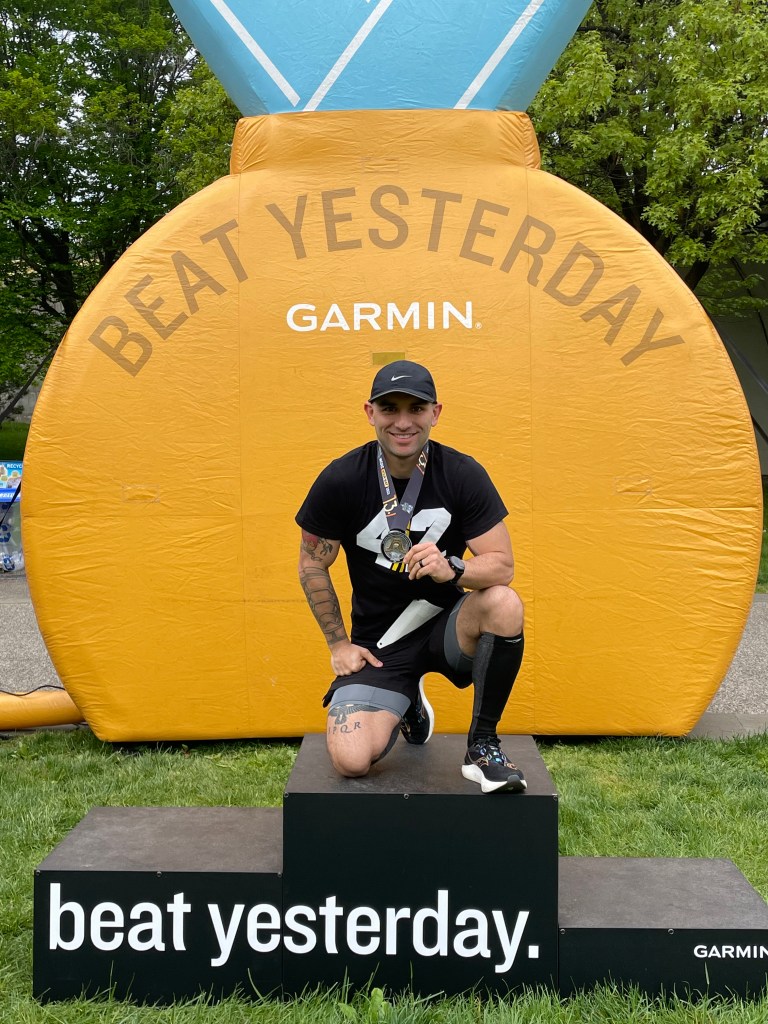
After the race, I felt a combined and overwhelming rush of elation, satisfaction, happiness, and relief. I took probably 5 minutes to just soak it all in, and it was one of the best moments of my entire life (after getting married and seeing my daughter for the first time). I was fighting back happy tears and a few (ok fine, more than a few) slipped out.
I put everything I had into this training block and this race–from the training, to the diet, to the focus on sleep and recovery, to the race-day effort. After my first marathon, I knew I had so much to give, and I committed to chase that and see just how much I could give. I am very hard on myself and generally a very intense person (if you didn’t already pick up on that). For me personally, this race really feels like a turning point in my running career. The “what if” and “so much more to give” feels even more open-ended now. I am driven more than anything by breaking through my own “perceived potential.” 10 months ago, I did a 6-mile run with max effort in just over an hour. If you had asked me then if it was possible for me to EVER run a half marathon at a 7:30 pace, I would’ve laughed.

 Pagoda Pacers News