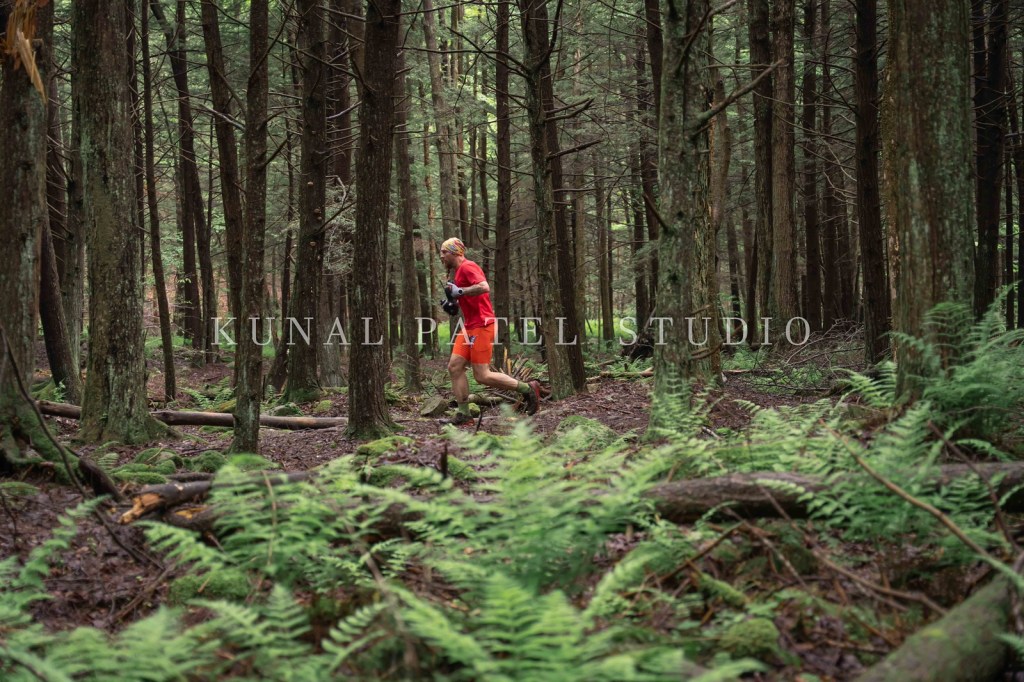
Race Report: Crazy Mountain 100—Still Crazy After All These Miles

by Meghan Cook

I love the Pennsylvania mountains, but how could they begin to prepare you for the fresh hell of Montana’s magnificent peaks? Cody Harris, as a Montana State alumnus, has a deep fondness for the state and the courage (or masochism) needed to sign up for a truly crazy event. The Crazy Mountain 100 webpage warns potential runners, “This is sure to be the craziest race you have ever attempted,” and boasts elevation gain of 23,000 ft, not to mention a base elevation of at least 5,000 ft above sea level. (I live at about 300 ft, for reference.)

We woke up at 3 a.m. on Friday and loaded up the rental SUV with coolers, food, sleeping bags, and gear, knowing that it would be a long time before we saw the Airbnb again. Cody was stressed, his watch telling him, “Body Battery: 6%” (Sidenote—what happens when it reaches 0%?) The only solution to prerace nerves is to start running, and Cody joined the crowd of crazies to hear a blessing from a member of the local Apsaalooke (Crow) tribe as the sun rose. The race kicked off at 6:00 a.m., with a few runners bursting out of the portajohn to join the herd as it took off for the mountains.
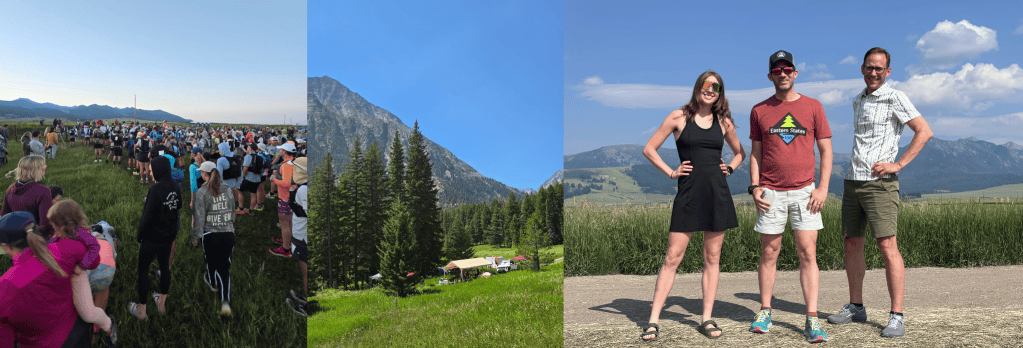
Then, the crew’s job began. Brittni drove us to the first crewable aid station, Ibex. Each aid station was accessible only via remote forest roads, and the parking situation was inevitably sketchy. At Ibex, Brittni drove up to a guy wearing a bright pink hat. 

Brittni: Can we park down there? 

Pink Hat Guy: No.

Brittni: Don’t you think you should stand back there to direct people?

Pink Hat Guy: I don’t work here.

You could almost hear him thinking, So fuck off, Karen. In retrospect, we rolled right past a sign that read, “No crew vehicles past this point.” We saw Pink Hat Guy repeatedly over the course of the race, and at the finish line Steve apologized to him over some foamy beer. Brittni remains unapologetic (well, he shouldn’t have been standing there). 

My first time crewing at an aid station, I waited among happy dogs, ringing cowbells, and the smell of pancakes. Family and friends lined up along the trail, many wearing custom T-shirts of their runner. Cody arrived a little ahead of schedule, and Brittni offered him a variety of foods, while I ran to replenish his water bottles and ice bandanna. Cody spilled some mashed potatoes on himself, Brittni wiped it off with her clothing, and sent him on his way. 

Cody left the first aid station in good spirits, but when we saw him again at mile 43, he had blisters on both feet. The top of the mountain was far wetter than we predicted (the surrounding landscape is arid) and mixed with a brutal climb, his feet were in bad shape. Brittni patched up his feet and put on fresh shoes and socks, and we sent him back up the mountain with Steve, knowing he was in for a world of pain. 

Brittni and I wouldn’t see the boys again till after midnight, so we tried to catch some sleep at the next aid station. Brittni blew up a sleeping pad for me, and I stretched out behind the car, sleeping bag zipped over my head against the bugs. I woke up in darkness to my alarm 90 minutes later. There was a dog yipping nearby, and Brittni assured me that he’d been going for a long time. On our hike to the aid station, we saw headlamps twinkling down the mountain, some alone, others in pairs. 

The descent from Sunlight Peak changed things. Steve originally planned to pace Cody through the night, but traversing the loose rock cliff face, in the dark, for half a mile of sheer terror, and at least a 20% chance of death (though not a bad way to go), Steve didn’t want to slow Cody down. Cody, at this point, was beyond caring much if he lived or died and wasn’t bothered by the potential free fall into shadow. Brittni switched Cody’s shoes and socks again, loaded up an extra battery, and Cody headed out solo into the night. 

I slept again on the drive to Forest Lake, the final crewable aide station before the finish line. We parked right next to the trail, and I kept sleeping until Brittni woke me up.

“Cody’s two miles away!”

I scrambled to get changed, eat something, and gear up. As Cody walked and then jogged out of the driveway and onto the trail, I could have skipped. Finally! Getting to do what I’d been training for. Steve told me and Brittni about the beauty up in the mountains, what we could only imagine from the aid stations below. Alpine lakes surrounded by mountains and snow-melt waterfalls. For the first ten miles or so, Cody seemed spirited. He was conversant and ran whenever the trail leveled out. We had one main climb that took us out of tree cover to fields of wildflowers under stunning blue skies. The trail unraveled before us, utterly exposed. Not a good thing for Cody’s burnt legs, and watching runners climb distant hills sucked the truth out of my assurances that “This is the last climb!”
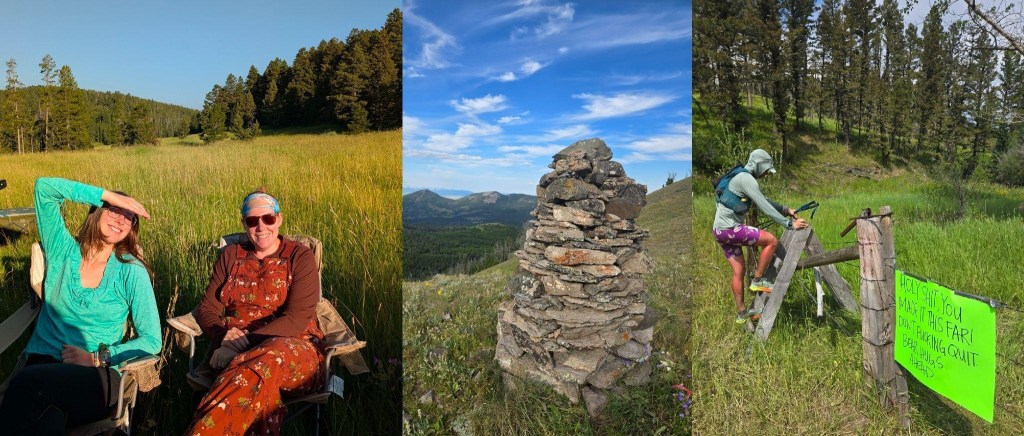
The last seven miles were the worst. Though finished with the mountains, the pastures spread infinitely before us, the farm where we would finish a mere speck in the distance. But even though his hip flexors and feet hurt, he kept taking painful steps forward. The body is incredibly resilient, and Cody went from a sleep-deprived start, to uncertain whether he’d be able to finish with blisters and 60 more miles to go, to sprinting across the finish line so fast I couldn’t get my phone out in time to take a picture. 

If you run into Cody and notice his shirt doesn’t fit right, it’s because he’s got a belt buckle the size of a dinner plate. Brittni ran the operation so smoothly that Cody’s only job was to keep moving forward and consume whatever she gave him. Crewing wasn’t easy, with driving two hours between aid stations with terrible parking.
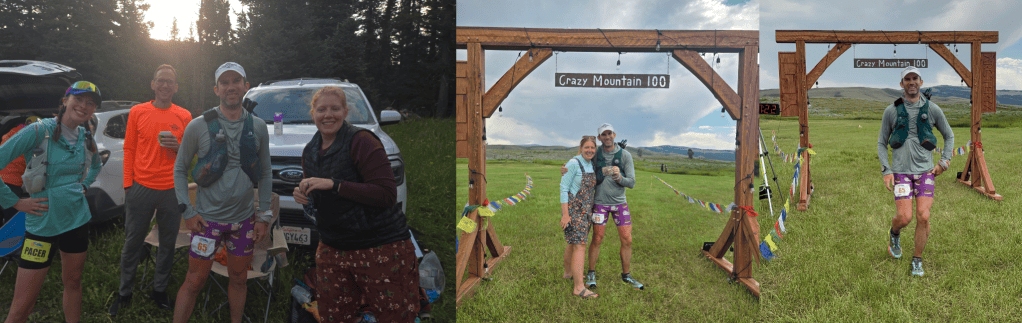
I’m so lucky I got the chance to tag along on this adventure (thanks, Matt, for taking a conflicting trip to Nova Scotia). The Pagoda Pacers sustain a culture that makes the crazy seem possible, and if you see me running far beyond that amount recommended to maintain a healthy lifestyle, blame the bad influence of my friends. 

What’s Cody doing next? Well, he might try to beat his 5k PR from high school, or raise the difficulty of running 100 miles by going unassisted. Whatever his goal, Cody is absolutely crazy enough to achieve it.
Race Report: Barkley Fall Classic

by Tania Salaneck

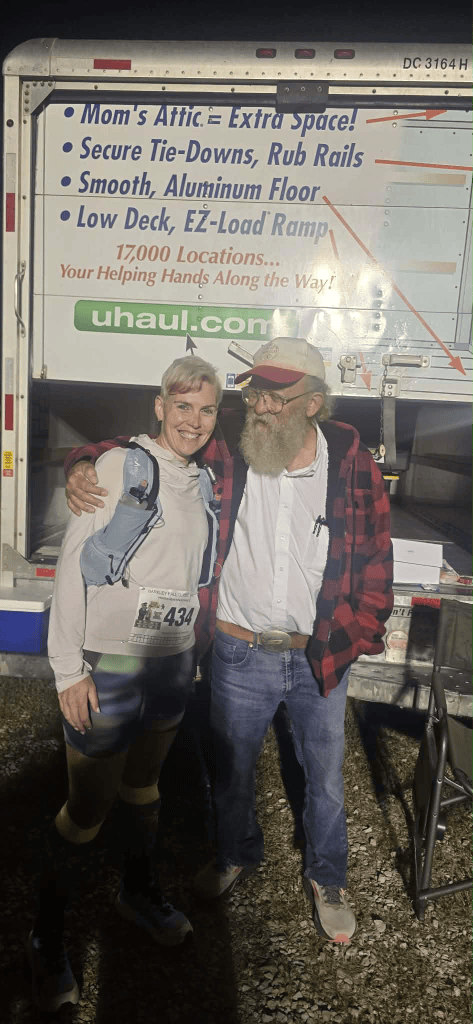
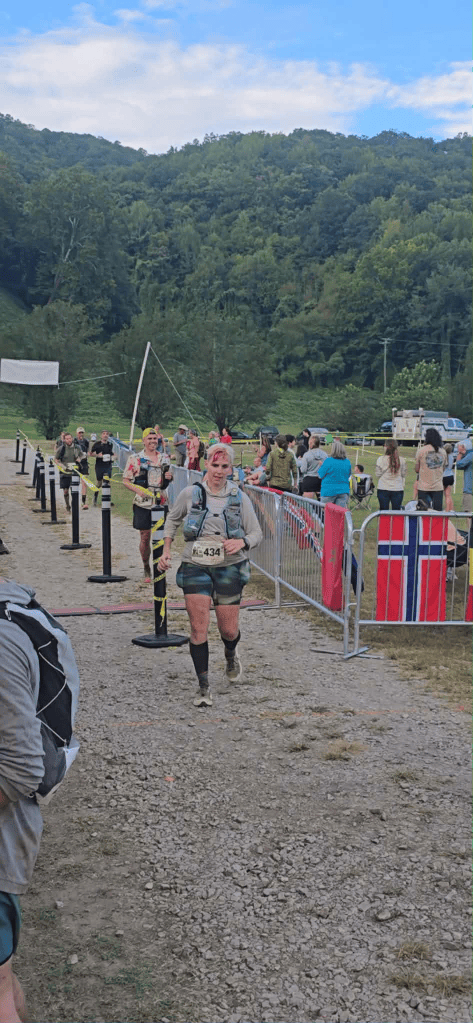
Anyone that has been in the ultrarunning scene for a while knows about the Barkley Marathons and Laz. So few runners get to experience this test, Laz created the Fall Classic as a way for more mortal runners to partake in the Barkley experience in a smaller dose. I’m not sure at what point I learned about this race, but last year, I decided to put myself in the lottery on a whim. I can’t take away from myself what I’ve accomplished over the past 15 years of ultrarunning, but I really didn’t think I had any business doing this race. While I have determination and a crazy amount of endurance, I’m not particularly fast. For whatever reason, Laz decided I should be running this race, so I started planning.

My summer had some solid training, getting into elevation in Blowing Rock and then Creede, pacing Maggie at Eastern States 100, and running 50k with Niki at Labor Pain. I was trained, if nothing else. We drove part way and then finished our drive to Oliver Springs on Friday, heading right to packet pickup. I felt an immense imposter syndrome as I listened to Laz talk about how the mountains formed and how Barkley came to be. We ate dinner at packet pickup but skipped the football game where the runners are welcomed into the community. I needed time to prep, and I wanted to try and get a decent amount of sleep.

With our bibs, we were given a compass, a whistle, and a cloth map of this year’s course. The course has minimal markings, and I watched groups of people gathering to scrutinize the map and discuss plans. I chose to forego that exercise. We got to our cabin, and I started pulling my gear together for the next morning. I knew from research that the briars on the powerline climb called “Rat Jaw” could be brutal, and runners had a multitude of approaches to handle this. I chose a pair of what hashers call “shiggy socks,” soccer shin guards, and a heavy-duty pair of work gloves. I had a ton of snacks packed in my hydration vest, and a cheap kid’s pedometer watch, since GPS is forbidden. Trekking poles are also not allowed, but runners can utilize any sticks they scrounge up on course.

The morning of the race, I made some coffee and had some pastry for breakfast—no skimping on calories! It took us about 15 minutes to get to Brushy Mountain State Penitentiary, where the race started. At this point, I felt oddly calm and really just wanted to start already. I got to talk to Laz for a minute prior to the ceremonial lighting of the cigarette, and we were off. Jeff went to his assigned volunteer assignment at aid station 3 while I tackled the first hill.

The first cutoff was an hour into the race, and Laz said if you couldn’t make it to the top of the road climb in an hour, you had no business pressing on. It was a steady climb, but nothing that felt horrible. We dipped into the woods onto some single track at the top, and I got into a rhythm. Then we hit Upper Rat Jaw. Immediately, there were multiple lines driving uphill directly under the power lines. Leaving that course would result in disqualification. There were heavy briars and other types of brush, in addition to the steep, loose dirt paths. In some sections, there were cables that could be grabbed, but having the gloves allowed even the briars to serve as something to grab to assist with getting up the hill. Since the course was just staying under the power lines, people were taking all kinds of different routes, crisscrossing under the wires. I was no exception, and I pressed up an alternate route with another woman, working our way under the briars in almost an army crawl at points.

We hit a wall of rock and had to wait our turns to get through the narrow channel cut through. Once we finally hit the top of the climb, we were scratched and bloody, but nothing really felt terrible. There was a fire tower just above Rat Jaw, and I got my first letter punched on my bib, which is one of the ways they can track that you’ve done the whole course. Then it was time to cruise some downhill. This is my happy place, the more technical, the better. I passed maybe 20 people on this section, and I had a few other runners comment that they didn’t know how I was moving like that on such technical trail. I explained that I live in Rocksylvania, and one guy told me it really showed.

Unfortunately, this section was also quite cambered, and I was still wearing those thick socks. I felt my foot sliding weirdly but didn’t think anything of it right away. Then I started feeling right heel pain. I decided to try and take care of my feet sooner than later, so they wouldn’t get any worse. I had a shear injury on the heel from all of that movement, which was essentially a very deep blister that covered the entire heel. I tried to drain it unsuccessfully and settled for throwing some kt tape on with my normal socks. I was still moving but had to slow on the descents. Every time my foot would land on a rock, my ankle would immediately try to roll, likely as a way of trying to protect my heel involuntarily.

I continued to push forward, and I really started pushing uphill, since I could control my foot placement a bit more reliably. Lots of people were using sticks on the climb, but I used the hands-on upper thighs approach. I passed maybe 25 more people in this section. I heard a very distinct whoop in the distance and knew I was approaching AS 3, where Jeff was. One of the volunteers told me I was the 48th woman. It was a quick stop for me, just topping off water and mixing two more bottles of electrolytes. With the temp in the 90s, this was a necessity. After I left the aid station, I pulled out the fabric map from my pack and realized that I could wring it out. This section was an old jeep road, and I did my best to keep running, despite again trying to turn my ankle on multiple occasions. A handful of people passed me in this section. There was another AS in this section, and John Kelly punched my bib before I continued on.

This jeep trail led back to the iconic yellow gate, and a photographer was there—I can’t wait to see that picture. I continued onto a section of road, back to AS 2/5. The cutoff was 4:20, and I got there a bit before 2. I asked one of the volunteers how I was doing on time, and he told me it was going to be tough to hit the final cutoff at the decision point in time. I had to be there by 5:20. I started climbing another brutal trail called Chimney Tops Trail and decided that I would make one more attempt at trying to fix my heel if I had any chance for the full “50k.” I very quickly realized it was a futile effort and pushed on. This is when it really hit me how well prepared I was. I don’t consider myself a strong climber, but I again passed many people and never saw them again.

Chimney Top climbed forever, and eventually I was back at the fire tower, which I now had to climb. Once down, I got another punch and now had about 20 minutes to make it down Rat Jaw…the whole way down. I think this was one of the few times where I wish I’d been going up. Down was brutal. I had my gloves still with me, and I used all the plant life I could along the way to break me from freefalling. I ended up in a pack with a few guys. The one caught his foot in the cable and did a split. Not long after, he said he needed to sit as we passed him. I thought he needed to gather himself after the fall, but I could hear him start prolifically vomiting behind me. This sped me up a little bit.

Descending all the way down Rat Jaw took way longer than I had hoped, and I watched the cutoff pass before I reached the decision point. I had passed the guys I was with and kept pushing. Then I heard someone behind me again and realized my vomiting companion was rallying. I let him blow past me. The last bit of descent was very steep, and I needed to crabwalk down a few feet before reaching the last gully as I approached the decision point. I fell forward hard but caught myself with both hands on the uphill without missing a beat. The spectators cheered for that, and I approached Laz. At this point, my time was stopped, but I was able to cross the finish line below for the “marathon” finish (most people calculated this as about 28-29 miles and ~9500 feet of vert). Jeff was waiting, they announced my name, and I earned my dog tag.

As soon as I crossed the finish, my foot decided I no longer wanted to be able to walk easily. We grabbed some food, sat on the grass, drank an amazingly cold soda, and I finally exhaled. This was a tough race, but I never felt like I was doing something beyond my ability. One thing I noticed, and I wish was not the case, was how few women were out there. We made up 22% of the field. I really thought about this after the race. I had the idea that I had no business being here, but I take that back. I have every right to push myself into these spaces. I really hope my fellow women runners take this to heart. You belong in these races, too.

Race Report: Vermont 100, 7/18/2026

by Andy Styer

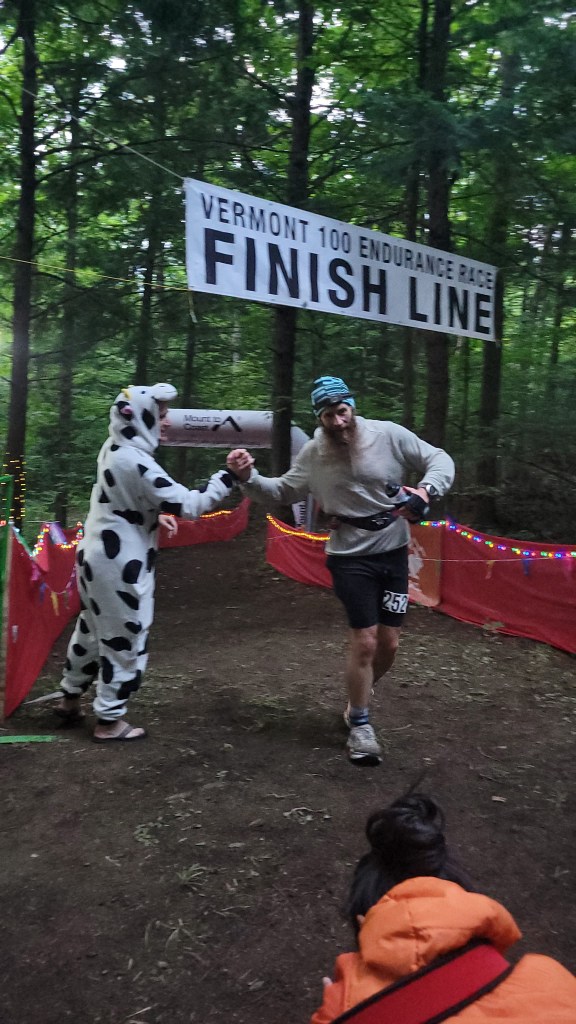
Keep moooovin’, Andy!

Although I have done many hard races, this was my first 100-mile completion. People who know me well would always ask, “When are you going to do a 100-mile run?” I would always answer in some sort of vague non-answer, or I’d just change the topic. To me, it wasn’t a big deal, and I always felt when the circumstances were right, then I would run one. I had a robust spring schedule planned and was going to roll into my favorite race, Laurel Highlands 70M, and then take a summer break of non-racing. 

Well, on Jan 4th this year, I received the unexpected news that my father passed. Besides turning my world upside down, I also was forced to scrap my spring racing schedule to tend to the more important things in life. It didn’t mean I stopped running; no, I actually ran more, but I just couldn’t spare weekends away at this time of the year. I did, however, complete Laurel Highlands in June. 

So, how did Vermont 100 even come on my radar? Well, for one, it’s part of my quest to knock out some of the older classic and iconic races. To date I have Laurel Highlands, JFK 50, Strolling Jim 40M, and HAT 50K, to name some. You could say it was a bucket list race. Also, the email came into my inbox on the day my dad passed. How could I not?

Onto the race. The course itself is shrouded in secrecy since it crosses a lot of private land, which then connects to a dirt road section and a few short paved sections. It boasts 16-17,000′ of vertical gain, and there are some big climbs, but there are just relentless, smaller rolling hills. The terrain isn’t terribly technical, but there is quite a bit of mud. This is more of a road shoe course than a trail shoe, although a good cushioned crossover shoe would probably work best. Another cool thing about this race was it’s also the only race that has a concurrent horse race! 

The race started at 4am, and my goal was to be as consistent as possible but not too fast. I was hoping for a sub-24-hour race. There are a lot of aid stations and water stops for this race, so I used a waist belt with 2 water bottles. The temps were on the cooler, humid side with a high of 75 degrees. It was overcast most of the day, and there were rain showers for about 4 hours. 

I was well on target for a 24-hour finish through about mile 80, and then I slowed quite a bit. My stomach didn’t want much food, and I also had a spell of nausea, which added to the overall discomfort of running for 100 miles. I finished the race in 25 hrs 44 minutes, off my goal but happy as could be!

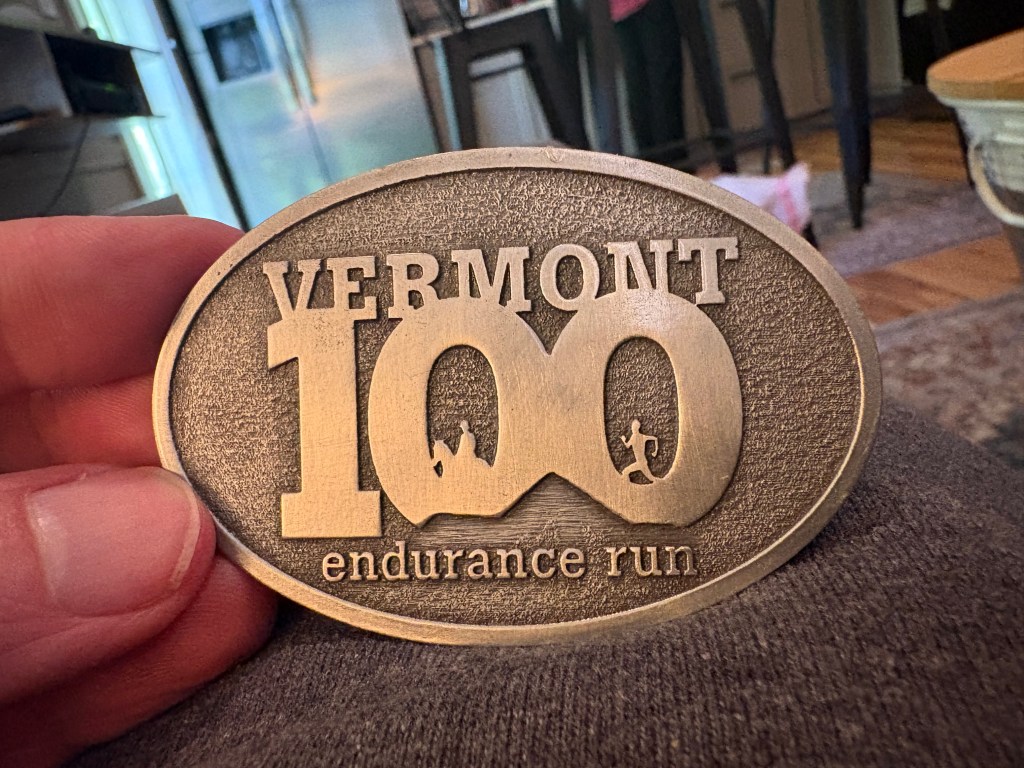
I did not use a pacer, but I had my ace crew chief and fiancé, Kim, to ensure I stayed on task. She doesn’t put up with my BS and also is great at reframing a negative mind. On this one, though, I had the confidence in myself to finish. These races are part physical and part mental. You have to want that buckle, and I did. 

Lastly, Vermont 100 is a fabulous race and has been around since 1989. The course is beautiful as it winds through the Vermont countryside. It supports Vermont Adaptive, which helps people with disabilities to get outdoors to do the things that we love, but with specialized equipment to do so. In fact, when I was running, there was a blind runner with guides to help her finish. Although this race is a little more expensive than the average 100 miler, this alone makes it worth it!

What are the other iconic races I am eyeballing? Western States 100, Old Dominion 100, and Wasatch Front 100 to name a few.

Thanks for reading!

Dr. StrangeBurrito, or, How I Learned to Stop Worrying and Love the Loop

As many of you know, I hate road running. For me, a single mile stretches into eternity and, while power-hiking is a staple in the woods, walking up a hill feels wrong on the roads. (I still do it; I just feel guilty about it.) So how did I find myself running countless loops around a single quarter mile block in West Reading for half of January?

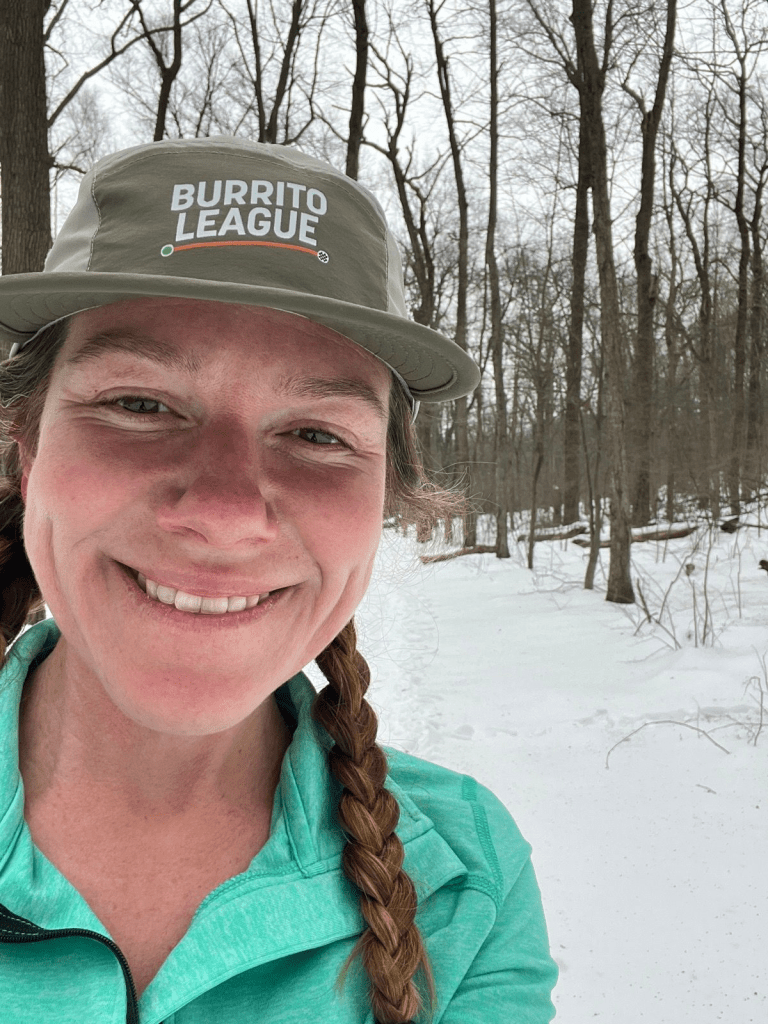
This year Burrito League* came to West Reading, thanks to the great folks at Fleet Feet (plus Comalli Taqueria and MountToCoast for donating prizes), and I ended up loving it more than I ever thought possible. The first day of the “challenge” I ran about 6 miles with fellow Pacer Brandon Beane, and as we finished our last loop, I joked that even running 10 feet into the next loop we were halfway done and might as well finish another. It’s wild how prophetic those words came to be.

One of the things I love most about running is the meditative state one can achieve. On a good day, miles blend seamlessly into the next; on a great day, miles blend seamlessly into the next, you feel good the entire time, your soundtrack doesn’t have a misstep, and you get to see some beautiful scenery along the way. I have a very hard time getting out of my own head when I’m pounding the pavement, but remarkably, doing 600 Burrito Loops was not the repetitive drag I anticipated; rather, it became a thoughtless, relaxing trance. (Sorry, I’m going to humble brag right now… or maybe not so humble…but if you didn’t do the math, I want to point out 600 loops is ~150 miles around the same quarter mile block, over the course of two weeks.) 😉

When I wasn’t zen-fully zoned out, there were so many community members cheering me on. I cannot emphasize enough how fantastic the staff at Fleet Feet is; they were/are so encouraging and welcoming. (It’s also never a bad thing to have an aid station every quarter mile.) I made friends in the most unexpected places, whether it be employees at the funeral home, bars on the block, residents in the alley, or the Sisco man making his weekly restaurant delivery. I was surprised by how many people were watching me run endless loops around this single block, and while they didn’t necessarily understand the compulsion to run during some of the coldest weather we faced this year, they were supportive, nonetheless.  

Saying it’s been hard to get out on the trails this winter would be a huge understatement. Burrito League gave me something to look forward to during some of the roughest times. I ran plenty of loops with long-time running friends, but also met and ran with awesome people I probably wouldn’t have otherwise. (Shout out to Brandon & Curtis, who each did a crazy number of loops, and Alex, who took the unofficial win with 700 loops.)

I know Thomas, Jason, and the whole Fleet Feet crew have some big plans in mind for next year, so if you get a chance and feel like getting a little loopy, keep Burrito League on your calendar. Even if you don’t go all in, just a few loops with like-minded people can be a wonderful reminder of why we run in the first place. I highly recommend it.

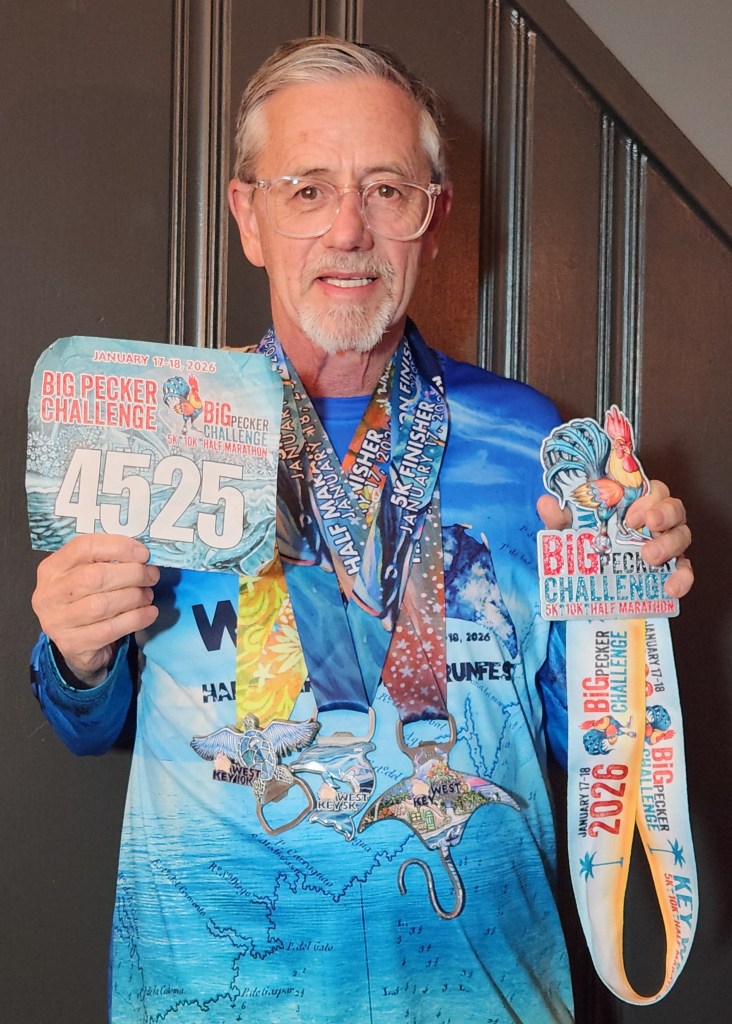
RACE REPORT: THE KEY WEST RUNFEST 5k, 10k, 8k, and Half Marathon (or, How I Earned the Distinction “Big Pecker,” and Why I’m OK with It)

by Tom Chobot

The Key West Run Fest took place on January 17 and 18, with the 5k and 10k taking place one hour apart on Saturday, and the 8k and half marathon on Sunday. In addition to the 4 races, the directors offer the “Big Pecker” and “Little Pecker” challenges. The BPC is doing the 5k, 10k, and half, while the LPC is the 5k, 10k, and 8k. They also offer a “Rum Stroll” and “Beach-n-Beer Mile” on Sunday afternoon, but we won’t talk about that. Suffice it to say that what happens in Key West stays in Key West.

“Oh hell, let’s go for the BPC. What could go wrong?” Even being fat, old, and out of shape (I’m speaking purely for myself here), the cut-off times seemed to be well within our ability level. 

Unbeknownst to us, until a few days earlier, Mike Whalen had also signed up, and the 3 of us had a great weekend running the races and checking out the city. 

The 5k started at 7a.m. and our strategy was to hold back and save enough for the next 2 races. Yeah right, like that’s going to happen. How many runners do you know who plan to “run easy” and actually follow through with it once the gun goes off? Anyway, after about a 30-minute break, and just as the rigor mortis was starting to settle in, off we went in the 10k, wondering whose brilliant idea was this? We all managed to easily make the cut-offs and spent the rest of the day hobbling around town and doing what people do here – see the sites and get our blood-alcohol back up to a respectable level. Well, I did anyway. Probably not the smartest way to rehydrate, but at my age, fun takes precedence over common sense.

The start of the half the next morning was festive as you would expect, but not without a few glitches. For one, 5 out of the 10 porta-johns ran out of toilet paper 30 minutes before race time, and at least one aid station ran out of water. More than a few unhappy runners. Fortunately, the weather was unseasonably cool, but still on the warm side for racing with plenty of runners struggling with the heat in the latter part of the race. However, considering it was 400 degrees below zero with 87 feet of snow on the ground back home, we weren’t going to complain one bit.

They gave us a finisher medal for each race plus one for the challenge and encouraged us to wear them around town. The only problem was that we looked more like Mr. T than runners with all the hardware around our necks. I might add that the Big Pecker medal makes the sound of a rooster when you push a button. Gotta love Key West. Still, it was a fun weekend and a gratifying accomplishment, as well as spending time with a fellow Pacer in a faraway place. Generally, it was a well-run event with a few hiccups that will undoubtedly be addressed. Nice course, lots of amenities, and enthusiastic spectators and staff. Bottom line, will we go back? Probably.  

5K (7am, Day 1) Tom- 29:41

                           Gwyn- 37:21

                          Michael- 27:57

10K (8am, Day 1)Tom- 1:06:35

                           Gwyn- 1:23:07

                         Michael- 57:16

1/2 Marathon (7am, Day2)

                           Tom- 2:36:29

                          Gwyn- 3:00:19

                          Michael- 2:08

Playing the Long Game: My Journey to the 2025 Philadelphia Marathon

by Lisa Domeshek

The Buy In

My road to the Philadelphia Marathon actually began in the fall of 2023. At that point, I had run a handful of 50Ks on the trails, but never a road marathon, and I was curious how different the two would feel. I was turning 40 the following year and thought tackling a marathon would be the perfect bucket-list challenge. I was initially interested in Steamtown or Philadelphia, but I also knew I’d be spending two weeks in Italy that fall, which was not ideal for marathon training.

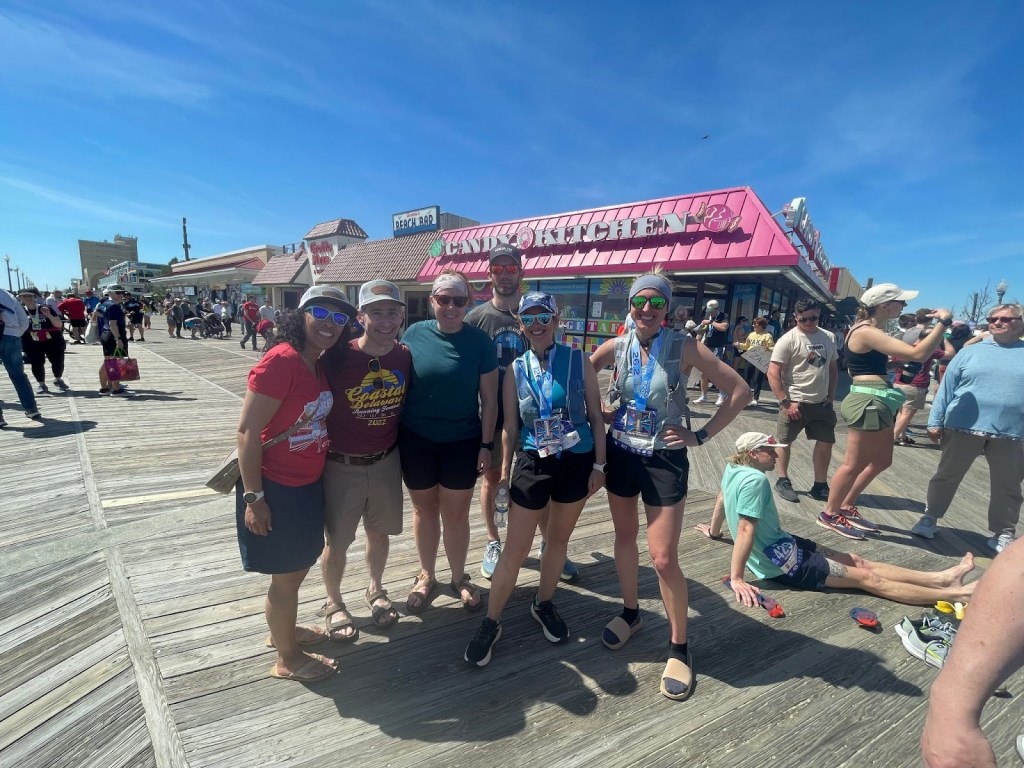
I was talking to Matt Brophy at Wine & Cheese that year, and he mentioned the Coastal Delaware Marathon. He’d run it before and planned to go back in April of 2024 to run the half. I signed up for the 2024 Coastal Delaware Marathon the following week.

It was a fantastic first marathon experience: midsized race, easy logistics, and a super flat course. A bunch of Pacer friends came down, and we had so much fun. My training had gone well, and I was excited to see what I could do. I had the best 18-mile run of my life–I didn’t stop or walk once–but then the wheels started to come off. The back half of the course is completely exposed to the sun, and temperatures climbed into the mid-80s. This was early April; I was not heat-acclimated at all. My calves tightened, I started cramping, and the last three miles became a jog-walk-hobble situation.

Despite the suffering at the end of the race, I was happy with my time. I also just assumed that is how I was supposed to feel at the end of a marathon. However, I was absolutely not doing that again! The last hour of the race was so hard. (Spoiler: by the time we got home from Rehoboth, a few days later, I absolutely wanted to do it again.) I had thrived with the structured training and knew I could run a better marathon. The only caveat was that I wanted a cooler race day. Philadelphia in late November? Ding, ding, ding.

Coastal Delaware, April 2024

Because of my travel plans, I didn’t want to run the full Philly Marathon that fall. But I did sign up for the half with Sandie Kincaid and had an awesome experience. I knew I wasn’t in PR shape because of travel and a nasty cold, which actually took the pressure off and let me enjoy the day. I’d never run a race that big, and the crowd energy blew me away. I signed up for the 2025 full marathon as soon as registration opened.

Upping the Ante

Knowing I had a big fall goal, I wanted to get to work early. I signed up for the Scranton Half Marathon with Blair Hogg, scheduled for April 2025. Around this time I also realized that if I was going to be running so much anyway, I might as well commit to Blues Cruise 50K, and if I was doing that, why not complete the entire Triple Trail Challenge?

I wanted Scranton to be a PR race. I trained hard from January through April and believed I could finally get that sub-2. It didn’t happen. That race felt hard very early, and although I had a great weekend with Blair, Karen, and Jerry, I was disappointed and started wondering if I was simply slowing down with age. I’m proud of myself for kicking that thought to the curb. Now it was time for two months of fun running before marathon training started in earnest in July.

In May I ran Broad Street just for fun, then the Charlie Horse Half at the end of the month. No pressure, just keeping my base mileage up. After that, I started hitting trails and hills to prep for Run for the Ages in June.

July 1st arrived and it was time to start building for Blues Cruise. I was in Cape May that week, and, lucky for me, Jules (Julia Hager) was there too! Our long run was 10.5 miles in 92% humidity and high-80s temperatures. Even at an easy pace, it was brutal, a character-building run I carried with me for the rest of the training block. Cheers to summer training in the Mid-Atlantic!

With Jules in Cape May, first long run of the training block

I decided to reuse my previous marathon plan since it had worked well. For this cycle, Blues Cruise would serve as my “marathon.” I had a few peak weeks close to 50 miles, which is a lot for me. Aside from the humidity, training was going great. I ran Double Trouble 30k in July and then the Curran Brewing Trail 5K in mid-August where I placed second in my age group: small win, big smile. Then came Labor Pains, which I planned to use as a training run, and I completed 50K.

Then it was time for Blues Cruise. I thought a 50K PR was possible even with the hot forecast. I ran really well through mile 28 and was still on track for a small PR…until my calf cramped so hard that I fell and literally couldn’t get up for a few minutes. Lying there waiting (hoping!) someone would run by to help me up was surreal. I went from cruising to wondering if I could even finish. Humbling, to say the least. And in retrospect, it was a great learning experience. It’s not over until it’s over. Eventually I inch-wormed myself up (no one came by) and prayed I wouldn’t re-cramp. Running was out of the question, so it became a three-mile death march I’ll never forget.

The following week, I went to Vermont and took a planned, glorious week-long break from running. I came back refreshed and ready for one more four-week build, which I planned myself, followed by a two-week taper. I raced the Oley 10-Miler in that block, felt fantastic, and earned a PR, another little confidence spark going into Philly.

All In

The morning before the marathon I went for a shakeout run. Strava helpfully pointed out this was my highest average heart rate in three weeks, and it felt like I’d never run three continuous miles in my life. Nerves.

After packing up, Jerry and I headed to Philly. We walked around Center City, grabbed my bib at the expo, and checked into the Sheraton Downtown. Later we met Steve Vida, who was also running the marathon, for an amazing dinner at Giuseppe & Sons—highly recommend if you want a nice spot downtown. Then it was back to the hotel to try to get some sleep.

Once I finally fell asleep, I got a few solid hours and woke up five minutes before my 4:45 a.m. alarm. I got ready quietly and had my usual race-day breakfast: a plain bagel with a tiny bit of peanut butter and a Red Bull. I walked alone to the start near the Art Museum, about a mile from the hotel. It was 34° but I knew the forecast (low 50s and partly sunny) was perfect.

I breezed through security, filled my pack, hit the porta-potty line, and got into my corral. I snapped a selfie and ate my first gel and then it wasn’t long before the National Anthem played and the first wave began at 7 a.m. I started running around 7:25. To my surprise, I felt happy and calm; the nerves were completely gone. I knew Jerry, Alyssa, and Jon would be at mile one, and focusing on spotting them helped keep me from going out too fast.

Ready to go!

After seeing them, I locked into pace. My goal was 4:15–4:20, which would be a PR, but still conservative. My rule: not a single mile under 9:30 for the entire first half, no matter how good I felt. And I felt great, almost floating. But experience told me the same pace would feel very different hours later.

I wasn’t expecting to see anyone again until mile nine at the zoo. I held steady between 9:30–10:00 minute miles, enjoyed winding through Center City, sipped Skratch from my pack, and got down the gummies and gels I’d planned for the first hour. I was targeting a minimum of 60g of carbs and 600mg sodium per hour, given my history of calf cramping.

Mile nine came quickly. The zoo area was packed with spectators–one of the denser parts of the course. I slowed slightly to look for Jerry, but I didn’t see him, so I pushed on. I did spot Dave, which made me happy. I found Jerry and the crew around mile 12.5 and stopped for a quick hug and selfie.

Selfie stop

Right after I crossed the half-marathon point, I had the completely unhelpful thought: If this were a half, I’d be done right now. And then, as if on cue, I saw Matt cheering. Perfect timing. I got my mental game back on track. 

Next I focused on reaching Manayunk, miles 19–21, which I knew would feel like a party. I got there before I knew it, and past mile 18, where I’d fallen apart in Delaware. I saw my friend Beth with the Philly Hashers, drank a small beer (planned!), then looked for Sorita and the other Fleet Feeters in their banana costumes. Found them!  Beth handed me another small beer around mile 21 and gave me a giant hug. A little aside about Manayunk: it was the most crowded part of the race with runners going in both directions and bacchanalian spectators. It was very hard to hold a steady pace with runners slowing down around me. I also almost got taken out when I bent over to pet a dog wearing a sign that said “Pet to Power Up” and a very large man barreled into me scaring everyone involved and did not apologize either. 

Steve had told me he loved the stretch after Manayunk because you’re headed straight back to the finish and can just count down the miles. That was exactly my experience. I couldn’t believe how good I still felt. I saw Ron and Helene Horn, and Dave one more time.

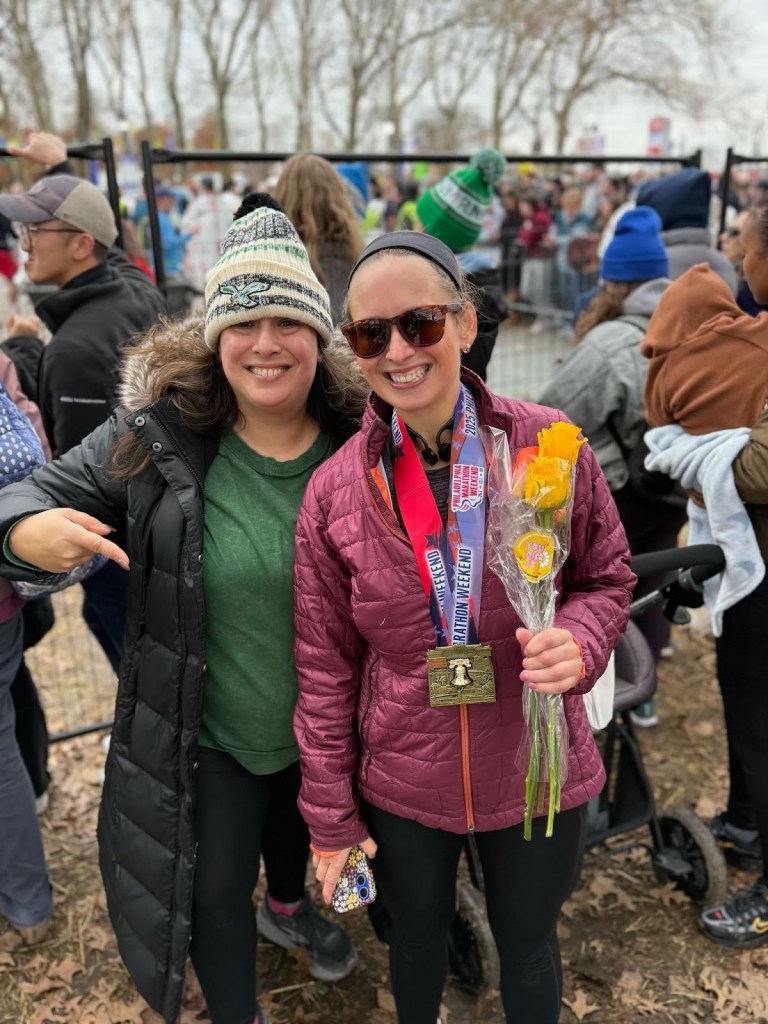
At mile 25, I couldn’t stop smiling. The crowds were unbelievable, constant high-fives, nonstop cheering, and the last half-mile was just a roar. I crossed the finish, got my medal, and realized I’d forgotten to look at the clock. My watch said 4:19 with a 9:45 average pace, so I assumed that was close. I didn’t check the official chip time until later: 4:22. Technically slower than my goal, but still a five-minute PR. My splits were pretty even; when they slowed it was because of the crowd or because I was looking for my people and I picked it right back up. My last two miles were 9:35 and 9:25. 

And honestly? The hugs, selfies, mini beers, and one porta-potty stop were worth every minute they cost so that I was relatively comfortable and still had fun. 

With my friend Alyssa at the finish

 Afterward, we met up with Matt, Steve, and a few other friends for a celebratory lunch at Victory Brewing. It was just a unicorn of a day: perfect weather, amazing friends, incredible spectators and volunteers. I wore my medal the rest of the day. (However, we will not discuss the Eagles / Cowboys game.)

We stayed in the city one more night. As we drove down the reopened Benjamin Franklin Parkway Monday morning, I saw crews taking down the banners and tents and couldn’t help feeling a little melancholy. I know there will be plenty more races, big running highs, miles with friends, and hopefully more PRs, but the 2025 Philadelphia Marathon truly felt like a little bit of magic.

Big-city races and/or road marathons aren’t for everyone, but I hope everyone who made it to the end of this gets to experience their own truly perfect running day in one form or another. 

Race Report: Eastern States 100

by Kelly Ammon

I ran my first “real” trail run at Monocacy Hill on a Wednesday Night Run with the Pacers (probably 2019?). I ran my first ultra at the Pacer race we all know and love, Blues Cruise 50k, in 2021. And I DNF’d my first race ever at Eastern States 100 in 2025.

ES100 was on my radar since I first got into trail and ultra running. It’s a bucket list race for a lot of trail runners, and it’s relatively local, so a lot of my badass friends have run it or attempted to run it. I knew I didn’t want to jump straight into a 100M, so I spent some time running shorter ultras (ha) before I pulled the trigger and signed up in 2024. Then lovely Hurricane Debby spoiled our plans. Ok, so I guess I’ll run ES in 2025. 

Leading up to the race, my training went really well. I won’t say I felt confident, but I felt as ready as I could to run a hundred miles in the woods on a technical course with 20,000 ft of elevation. Even the week leading up to the race and the night before, I didn’t really feel anxious, but excited and ready to go. 

On race day, everything was completely fine. Not great, not good, not bad, not terrible. But fine. The weather was warm and humid, but not out of the ordinary for PA in the beginning of August. I got some hot spots/blisters pretty early on, but nothing devastating. My nutrition and hydration plans were working out, and I got through the first 43 miles without any major problems.

Steve Vida jumped in to pace me at mile 43, and by mile 45 the wheels were coming off. (I cannot stress enough that Steve is a wonderful pacer, and my downward spiral had nothing to do with him. He is truly great and all would be lucky to have him.)  

I found myself in a funk I could not pull out of. I cried for…..7 miles. Steve said it was only 2, but I know he was only saying that to be nice. Physically, I was fine. My legs were tired but no more than at other races. I wasn’t having stomach issues either. The biggest problem was my brain and convincing myself to keep going. 

My reason for running has always been because it’s fun. Yes, there are plenty of times I don’t want to keep going, but that feeling goes away by the next mile. Or rather, the end goal is worth the suffering, and that’s part of the fun. What do you do when your main reason for running goes out the window and no one is forcing you to go on but yourself? (And maybe also Steve when he won’t let you drop 8 miles earlier.) In the woods at ES, I looked at my watch and said, “I have to keep doing this for FIFTEEN to TWENTY more HOURS?!” and that’s where despair set in. So I quit. 

I’ve thought a lot about the race over the past three weeks. Do I regret dropping at mile 58? No. Would I have done a lot differently both leading up to and during the race? Absolutely. Am I someone who never finishes a hundred mile race? Maybe? I’m not saying never again, but I’m also not itching to sign up for a redemption race. Right now, I’m going to focus on races that I think will be fun. I guess if I had to sum up my feelings and experience of my Eastern States 100 DNF, I’d have to say “medium.”  

Race Report: Double Trouble 15k

by Blair Hogg

This race has never been on my radar. I’m not sure why–maybe because it is in July, and it’s usually too hot to consider a longer trail race? This year, a few people I knew said they were running it, and I needed a nice long run, so I decided to give it a try. Besides, Ron Horn and the Pretzel City Sports crew usually put on a decent race. 

The race is held in French Creek State Park, and I have done the Dirty Bird race there several times, so I figured it would be similar. Dirty Bird is fairly hilly, and with the heat and humidity, I wasn’t expecting to set any records. Besides, it would be fun to try to run with some friends. 

Michelle Henry, Julia Hager, Michelle Foley, Shawn Weller, Jason Tolley, and Lisa Domeshek were all running the race as well. Lisa and Jason were planning on running two loops for 30k; Julia was going to try for it as well. The rest of us were too smart for that stuff. 

The race started near the pool, but it didn’t follow the DB course. It was similar, but not too much. Shortly after the start, the course hit some narrow single track, and it became one big conga line. Eventually things sorted out and everyone could start doing some running. Once we crossed the main road and got onto the trails, things settled down. 

It was hot. And humid. And you were tempted to walk the hills. But when you started walking, you got ambushed by mosquitoes. It was horrible. At least it was good motivation to keep running. 

The hills weren’t nearly as bad as I expected, given my experience with DB. You could keep a decent pace going most of the time. Some of the trails used were very technical, though, and it was hard to get into a nice rhythm. 

Lisa and Jason needed to keep a decent pace going, since there was a cutoff at 2 hours and 10 minutes to do the second loop. Julia and Michelle Foley got ahead as well, so I tried to stay with Michelle Henry, but needed to keep some pace going to stay ahead of the bugs. We eventually met back up later in the race and ran the last mile together. 

Unfortunately, Julia and Michelle got off course by missing a turn, and ended up finishing behind us. It was a bummer for them and several others. 

I finished in about 2 hours and 15 minutes. I probably could have made the cutoff if needed, but I kept expecting bigger hills and held back. Most of the hills were pretty manageable. 

But the bugs! They were awful!

And the heat and humidity! By the end of the race, I looked like I had gone for a swim in the lake!

All things considered, though, it was a fun event, and something I’ll probably consider doing again. 

Race Report: World’s End 50k and Laurel Highlands 70-Miler

by Andy Styer

The “World’s-End-and-Laurel-Highlands Double” seems to be my thing. In 2022, I completed the World’s End 100K and Laurel Highlands 70.5 mile races on back-to-back weekends. In 2024, I completed the World’s End 100K and Laurel Highlands 50k on back-to-back weekends. This year, I completed the World’s End 50k and Laurel Highlands 70.5 mile races, but there was a 2-week gap. Why would one do such hard races in close time frames? Well, there is no real reason except that I can! 

World’s End 50K

I have done the 100K 4 times, with 3 finishes and 1 DNF. This race, in my opinion, is one of the hardest out there. The terrain, the hills, and mud make this one a handful. This year, with all of the rain, the mud was the worst I have seen. There was nary a dry spot on the course, and the stream crossings were as high as they’ve ever been. The temps, however, were cool, which I think helped out a bit. The race itself went rather well, and I set no hard goals for this one. I kind of hung back at the start and waited until I got in a groove. That groove ended up being so groovy, that I missed a turn and tacked on almost 2 extra miles! I had to re-pass a bunch of people I had passed, and, with 3 miles left, I turned on the gas and passed at least 10 people who had had enough of this race! I did have one, nice, headlong fall in the mud, which added to the “spice” of finishing with my slowest 50k time of 7hr 37 min. The elevation gain for this bad boy was 6339′!

Laurel Highlands 70.5-miler

This was my 4th year doing the 70.5 miler, with 3 finishes and 1 DNF. I also have done the 50k one time. This is an old school, classic, point-to-point race, which runs the entire Laurel Highlands hiking trail. This is the 46th consecutive year, and it’s just a fabulous race. The mountain laurel is always in bloom this time of the year, and, unlike World’s End, every stream crossing has a wooden bridge. The terrain is fairly technical, and the elevation gain is 11,500′ for the 70 miles. Another cool thing about this race is it crosses over the PA Turnpike via a special bridge for the trail. 

This particular day wasn’t really hot, but the humidity was OFF THE CHARTS from the start. I drank over 5 gallons of fluid during the race. I finished with my slowest LH time (18hr 44min), but it was another rewarding day of perseverance. I couldn’t remember a time during the race when I had any real low points. As for now, it’s rest time for the summer, as I enjoy some more casual and recreational running. 

Thanks for reading!