The Inca Trail Marathon

A race report by Michael Whalen

As it was for most of us, the COVID Years were not fun for me. I found myself working way too many hours and not taking much time to run or engage in much social activity. In November 2021, I found that my state contract was ending and I had the opportunity to take a few months off of work. I was not sure how I was going to spend the time off, but I knew I wanted it to be epic!

As I was deleting a ton of old emails, I saw an email from “Six-minute mile”. I usually delete these without opening them, but I decided to open this one. I am very grateful that I did. There was a small write up about “The World’s Most Difficult Trail Marathon”. That piqued my interest, and the more I read, the more I wanted to research how difficult the Inca Trail Marathon could be. My research revealed that only a few people are entered into each race and the conditions are like no other (as you’ll see in the photos below). As we all do, I decided to pull the trigger and attempted to enter the September 2022 event. Quite rapidly, I was declined entry. Oh, well, I most likely would have had a DNF anyway. I started to investigate other options (Frozen Snot, Hyner View, Laurel Highlands, Vietnam 70k, Call of the Wilds).

A few weeks after the notice, I received an email from the race director asking if I desired to run the August 2022 Inca Trail Marathon. Within minutes, I was sending my credit card info and officially entered in the “World’s Most Difficult Trail Marathon”. I did research and found that most hikers complete this trek in 3-4 days and the FKT is 6 hours 24 minutes (for a marathon!) 

Training: I began training on New Year’s Eve with a hike down Mt. Penn, laps on Weiser, and a race to the Pinnacle. Since I signed up for the Rocksylvania Elevation Challenge, I thought I would begin using this virtual race as the start of training aggressively. For 3 months, I did more hill repeats than I could count. I was lucky to have more than 15 local runners to help me reach a 3-month goal of 141,243 feet of elevation and 702 miles of running. I was excited to have been the overall winner for the challenge. Training was right on schedule. I tapered back and trained with the “run what feels right” theory. I found that in previous years, I really was overtraining. HITT and time in the weight room helped to get me ready for this adventure. The above races went well, and I was really pleased with my performance. In June I hit the trails hard and did a moderate taper in July. I really did my best not to become injured as the race date became closer!

August 3, 2022: The eve of my departure from Philadelphia to Lima. With a full day of nothing to do, I studied the course again and attempted to make a race day plan. The first two climbs are the hardest and taking them somewhat slower may be the best plan of attack. I continue to worry about the acclimation to high elevation. The highest point is nearly 14,000 feet above sea level! I decided to Google the most difficult marathons in the world and across the board this is what I learned:

“While some marathons are described as the world’s most extreme, the Inca Trail Marathon is unquestionably the most difficult. Starting at an elevation of 8,650 feet, the treacherous course features more than 10,400 feet of elevation gain, 11,000 feet of elevation loss and two high passes of 13,000 feet and 13,800 feet. Often described as the equivalent to running a tough 50-mile trail run, the marathon is limited to just 40 to 50 people and sells out quickly. The payoff, of course, is the luxury of running (or walking) across the fabled 500-year cobblestone path amid spectacular views of the Andes Mountains and crossing the finishing line in the legendary Lost City of the Incas.” (www.andesadventures.com)

For the first time in many years, I became worried about race performance. To be honest, I was actually scared about the difficulty of this marathon. But I knew I’d find out what I had gotten myself into in a few days. 

August 4th: We arrived in Cusco (11,000 feet above sea level) late the previous night. I was only able to sleep for four hours, wide awake at 3:30 am. I had a slight headache and an oxygen saturation level 78%. Usually that would be considered a medical emergency, but I knew it was due to the altitude. I rested, drank plenty of water, and began taking Diamox, an altitude sickness prevention medication . 

The team of athletes: We all quickly became friends. As we casually spoke about previous experiences, words like Mr. Rainier, African Safari Marathon, Pikes Peak, Kilimanjaro, 7 continents in 7 days, Great Wall, Everest Base Camp Marathon, Antarctica Marathon, the Germany Rennsteig Marathon, and many more were discussed. What did I get myself into? There were a ton of hard-core runners there.

August 5th: We had an 8:00 a.m. meet time to go on the initial 5-mile acclimation hike. The hike was slow and not very long, but I had noticeable breathing issues. After short periods of rest, the breathing quickly improved. 

August 6th: The first run. We had a controlled downhill 4.5-mile run. The breathing was much easier and there were a few times that 4-5 of us were going at it hard. Toward the end of the run there was a nice, paved area where I was able to let it rip and it felt really good. The day ended with me providing a “how to use poles on trail” class for a few of the accomplished street runners 

August 7: Tragedy strikes. We had another slow 4-mile downhill scheduled. I decided to run in the middle of the pack and take it nice and easy. 100 yards into the run EVERYTHING changed. I rolled my left ankle badly and heard something snap. The person behind me witnessed it and stated, “Oh my God!” I thought that I could run it off but after a mile, I knew I was in trouble. Just as with the race course, there were no exits from this trail. Once I started running, I was committed to get to the end. My mind was racing at 1,000 MPH. Was this it? 7 months of intense training–being careful as often as possible–over 1,000 miles and 140,000 feet of vertical training wasted? To say I was emotional is an understatement.

Then the trail magic began. As soon as I arrived to the bus, it was obvious to everyone that something was wrong. I was placed on the bus steps so I could remove my shoe for an initial assessment. The balloon effect was nauseating. Within minutes I was assisted to a seat, someone applied pain relief cream, 800 mg of Motrin was provided, and condolences were received from everyone. The arrival to the hotel is foggy. Someone carried my pack, and another held me upright on the way to the dining room. I sat down and someone from the team got me a plate of food from the buffet. My leg was elevated and I received an ice bag from the kitchen within minutes. My sadness and dejection was very obvious.

My first savior arrives. Jill is an extreme hiker and a physical therapist. She did an initial assessment, and her impression was not easy to hear. Her plan was ice, elevation, and Motrin followed by a complete assessment after the tour tomorrow. Somehow I was checked into my room and my bags arrived. Packed in ice, on to pillows and nothing to do but reflect. It was a horrible few hours. In late afternoon Adam called and asked if I could join him for a coffee. I declined. The last thing I desired was to be around people, but I changed my mind and joined Adam, Tina, and her husband; they were very reassuring and calming. As we spoke, Tina (savior #2) offered to provide acupuncture for pain and swelling. I was overwhelmed with this opportunity. We decided to wait 24 hours. Motrin, ice, elevation, and no weight bearing until further notice.

August 8th: complete rest. I opted out of the tours and hike to completely rest. Every person on the trip offered emotional support and healing advice. A lot more happened on August 8th. The ankle was swollen–black and blue to my knee–and the race director told me I was unable to start the marathon. I haggled for a final decision after the 9-mile hike to base camp, or to start the race and at the turn for the 30K v. Marathon decide then. The RD said I couldn’t do the Inca Trail Marathon. He explained that the 30k is just as difficult and it is on the Inca Trail. 

August 9: Hike to base camp. Swollen and bruised but with NO pain. The hike went well, and I ran past the RD to show I was good to go! He again explained that I need to run the 30K.

August 10th: Inca Trail Marathon report. The porters went through camp at 2 a.m. ringing the wake-up bell. Ugh, it was raining hard. We all donned rain gear and headed off to the breakfast tent. 3:30–the rain stopped, and we walked 20 minutes to the Inca Trail entry point. Exactly at 4:00 a.m. the marathon and 30k began at the sound of the whistle. We all immediately began the 1st climb of 3300’ in 6 miles.

Mistakes happen. I was feeling great at the mile 3 split until I accidentally turned the wrong way. “Oh no, I am on the marathon course–NOT the 30K course.” The first climb up to 11,900′ above sea level had decent terrain, although I was overly cautious to prevent additional injury. This portion was an out-and-back with 2 water stops. We turned around to a beautiful sunrise over the snow-capped Andes Mountains. In an unprecedented race move, I stopped to take photos and to talk with other runners on this “out-and-back” portion. I had a strange emotion when I realized that I was in 5th place at checkpoint 2. We passed very basic homes, beautiful mountain views, some streams, and chirping birds. The tranquility was indescribable.

As soon as the downhill from the first summit ended at at mile 10 in Wayllabomba, we began the dreaded ascent up Dead Woman’s Pass. I trained hard for this section, but she humbled me quickly. I entered this 20%, 2 mile, 4,000’ of gain monster in 8th place, feel really strong. The Dead Woman slapped me in the face hard. The thin air climbing to 13,800 feet made breathing extremely difficult. Pushing as well as I could, I was able to do 1-2 (not a typo, one) mile per hour. We were in or sometimes above the clouds, so there were not many distractions. I had my Coros watch on high elevation mode and was delighted that the altitude sickness danger alarm did not activate. If my memory is correct, I did say “Hi” and pet a wild llama on the way up. 6 hours into the race, mile 13–I summited Dead Woman!!!!! The hardest of the three climbs was completed–one more major climb to go.

I cautiously descended Dead Woman and began the difficult 1,200′ climb up Runkurankay Pass. Although this is our final time at 13,000 feet above sea level, that fact was not reassuring. I caught a few of the struggling 30k racers and stopped to provide encouragement. It was also amazing to see dozens of porters with 80-pound packs passing by on both the up and down hills. The were all very kind and encouraging.
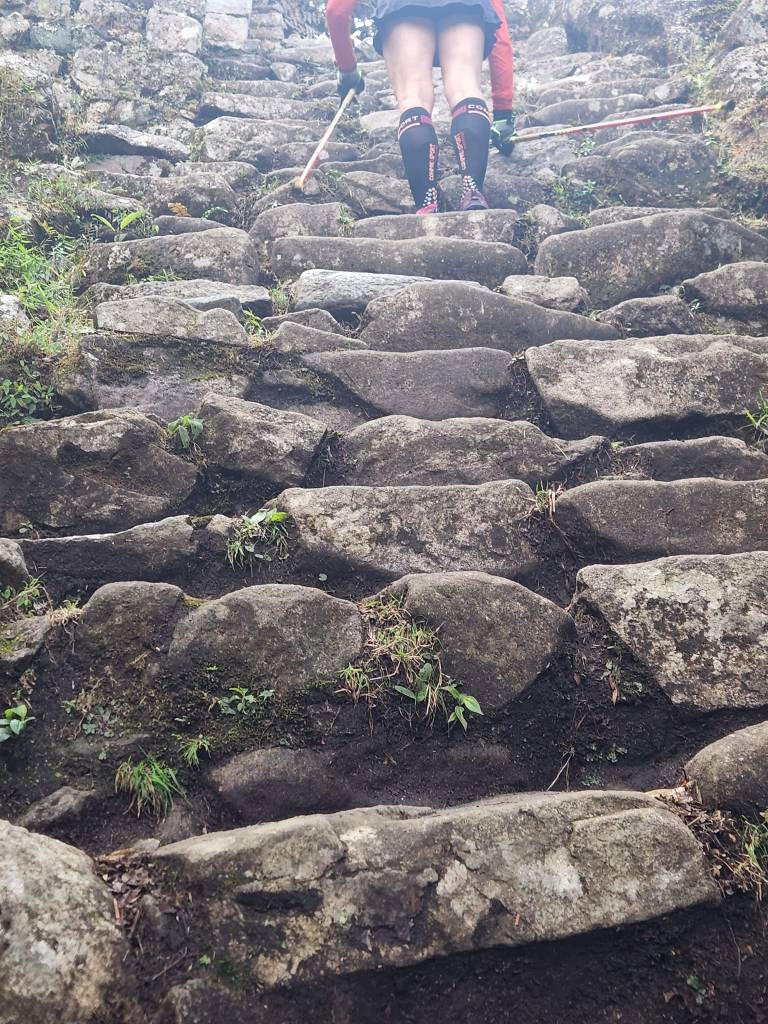
The research I conducted made me believe that the 70,300 “steps” that we were going to encounter were more like our traditional stairs. These steps were basically sets of lower cobblestones. 80% of the trail was cobblestone and not much of that was runnable. The mountains and jungle vegetation were very enjoyable. We were hopeful to see monkeys but none of us saw any. I did not push any of the downhills in fear of trashing the ankle anymore than it was. At mile 18, I remained pain free but could feel the swelling was increasing. Most of the 5 aid stations only had water. The best aid station (mile 16?) had soup, bars, a simple sandwich, and Gatorade. It is hard to believe that all the aid station supplies needed to be carried 6 or many more miles.

Somewhere around mile 18, Olga from our group caught up to me. Olga and I were passing each other frequently and decided to finish the final 7 miles together. I usually enjoy racing alone but found that the both of us were using each other to keep a good pace. It seemed like that final 10K was taking forever. There was no flat terrain as we conquered through Phuypatamarcia at 12,000′. The miles were slowly clicking off and Winay Wayna, the next landmark was getting close, but I was out of water. We were both grateful that we will easily make the cut off time of 11.5 hours to get through the Sun Gate. Those that did not make the gate needed to take an extra 5-mile detour. Runners that crossed the finish line in more than 13.5 hours also needed to walk 3 miles to the hotel. The only way to arrive in the town of Macau Picchu is by train or foot. There are no roads to the town. The only road is down to the ruins. The bus only operates from 9:00 a.m.- 5:30 p.m. 

We were delighted to see one of our tour guides at the Sun Gate. We checked in and prepared for the final 4 k of the race. Water bottles were filled and off we went! Within a relatively short period of time, we were able to see one of the seven wonders of the world. The Manchu Picchu ruins seemed to appear 20 miles away, but the adrenaline was kicking in and we increased our pace. With less than a half mile to go, we were met by Olga’s son. The excitement to see him and to learn that we were this close to the end was exciting. Around a bend we see Freddy, our guide, and Olga’s family holding the finish line ribbon. How freaking exciting is this! We finished 6th and 7th in the world’s most difficult trail marathon in 12 hours and 20 seconds. Finish line hugs and photos and we head to the bus. 

Ugh, the steps down to the bus took about 20 minutes. The line for the bus was 30 minutes long. I just wanted to take off my shoes and lay down. We arrive to town and learn that the long walk to the hotel was also uphill. We finally checked in!

The next day. Early breakfast to catch the 9:00 bus to the ruins of the lost city. Well, since we were there, we might as well climb the half mile, 970 feet of vert up Huayna Piccho Mountain to see the epic views of the ruins. At 9,000 of elevation, we are again as high as the clouds and the view is wonderful.

The next day we travel 7 hours by train and bus to be in Cusco for the award ceremony.

The award ceremony was very emotional for everyone. This incredible group of athletes became a very tight family. There was plenty of applause, hoots, hugs and happy tears. Additional race photos: https://www.facebook.com/photo/?fbid=2181744685347713&set=pcb.2181750582013790

WARRIORS….COME OUT AND PLAAAAAAAAY

A race report by Michelle Henry

Let me start off by saying I’m so excited that I was finally able to do this run! I had been so jealous and wanting to do this since Steve Vida, Jon Durand, and Jason Karpinski did it in 2020. Full disclosure and spoiler alert — I still haven’t done the whole run. But I did 17 of the 28 miles, and I’m proud of that!

What is The Warriors UltraRun?

The Warriors UltraRun is an overnight, underground running experience that covers 28 miles, as participants re-create the escape route from the iconic 1979 film by Walter Hill. After attending a 1 a.m. Conclave, held at a secret location in the Bronx, runners pass iconic shooting sights as they race for Coney Island. It is an unofficial race run by fans, for fans. 

This was the 4th annual running of The Warriors UltraRun, which has evolved so much since the founder, Todd Aydelotte, ran the route solo in July 2018. This was also Steve Vida’s 3rd time running it. 

The event itself is more fat-ass than race. There is no swag, no aid stations, no timing, no bibs; however, this year (as opposed to previous years), we did get a marked course…sort of. Turns were tagged with “W” and an arrow in chalk. You can read more about it in the article featured in the New York Times last year. 

How do you prepare for an overnight run through NYC?

Our prep involved a meeting a few weeks prior to the run, hosted by Steve, complete with a presentation, which included a map of NYC with plotted out (and linked) locations and images showing each of the gangs in the movie and a bit of background on them. Steve was obviously super-excited about our upcoming adventure, as was I.

At the conclusion of the presentation, we watched The Warriors movie and then discussed and decided on our costumes. That’s right–costumes. So not only did we start this run through New York at 1 a.m. and run through the night, but we will also did it dressed as members of an imaginary gang. We decided on being the Hi-Hats, and we each left Steve’s with an info sheet, which he also posted as a PDF on our Facebook group. I mean, really, there wasn’t a more prepared gang of mimes in all of NYC. Steve’s prep for this run was top notch! 

Who are the Hi-Hats?

The Hi-Hats are a fictional New York City gang in 1979. They are a quiet, but solid clique from Soho, and they dress like mimes. However, on July 24, 2022, the Hi-Hats were Steve Vida, Julia Hager, Jason Karpinski, Curtis Musser, and myself.

How was the run?

We hopped on the subway and arrived at the pre-run gathering spot, The Tortoise & Hare in The Bronx, at 11:30 p.m. We grabbed a pre-run drink and mingled amongst other runners from all over dressed as gang members. At 1 a.m. we all gathered in a nearby location for the conclave, lit only by headlamps. After listening to an audio replay of a clip from the movie, the race begins at the sound of the gunshot that kills Cyrus. The elite team of Warriors get a bit of a head start, and we are off to chase them all the way down to Coney Island.

The night was hot….I mean REALLY hot.  Even at 1 a.m., it was 80 degrees, and the city streets that hold the heat made it feel like it was in the 90s. We did our best to stay hydrated by stopping for water and snacks at bodegas and stores along the way. We hit Columbus Circle at 10 miles, Time Square at 11 miles, Union Square at 12 miles and the Brooklyn Bridge at 15 miles. Along the route we had our own local tour guide (and fellow runner) who kept popping up out of nowhere to show us points of interest like where Malcom X was shot and what running groups run in particular areas, which was pretty cool, but it was also weird when he pointed out places like where he went to elementary school and where his grandmother died. 

We made it to the Brooklyn Bridge as the sun was coming up over the city. I was so freaking happy to see that bridge! The sky was colorful and provided a gorgeous background to the structural elements of the bridge itself as we walked over it. Yes–walked. At this point, I had hardly any juice left and was really hurting. Thankfully Steve pre-planned an escape route for Jules and I after we crossed the bridge. Our hotel was just a few blocks away. We hobbled our way back to the hotel as the guys continued. Now able to run at a faster pace, they picked off several other gang members (13?) on their quest to get to Coney Island and finish all 28 miles of the run. 

Brooklyn Bridge

After a bit of rest time, Jules and I took the NYC subway and made our way to Coney Island to meet the guys on the boardwalk for the finish. 

Subway Warriors
Curtis is still wearing his hat!

Overall, this run was a lot of fun. There was no point throughout the night where I felt like we were in a sketchy situation or unsafe. There are places to stop along the way for refueling and plenty of things to see. The experience of running through the streets of New York in the middle of the night with some of your favorite people is one I highly recommend!

Race Report: Coventry Woods Trail Running Festival

by Kelly Ammon

After running Dirty German 50M in May, my plan for the summer was just to take it easy. No goals. No training schedule. No races. The plan was going smoothly until one day a notification popped up on my Facebook feed. (Damn you Targeted Ads!) Big Woods Running Club was having a Memorial Day special on their TrailFest. I could now suffer just as much but for less money! Perfect! 

I immediately texted Andy Styer, fellow Pacer and one of the race directors. 

[Actual transcript]:

Me: I can’t decide if I should sign up for your 10k or do the 3 hour one. Lol.

Andy: Well…the 6 hr sounds like fun : )

Me: Hahah. I’m trying to be responsible/take it easy

Andy: Well…then 3hr!

Keep in mind, my plan for the summer was just to take it easy. No goals. No training schedule. No races. Also keep in mind, Andy Styer is the most wonderful kind of crazy that will run World’s End 100k and Laurel Highlands 70M on back-to-back weekends

I compromised and signed up for the 3 hour.  

The morning of the race, I couldn’t have asked for better weather. I mean, I guess I could have, but it was mid-June in Pennsylvania and the humidity was less than 300%–in other words, ideal. Jokes aside, the weather for race day really was perfect and made the day much more enjoyable. I arrived at the course about 45 minutes before start time, made my way to check-in, got my race bib, and was handed the softest t-shirt I’ve ever owned. After moseying around for a little while before start time, I made my way to the port-a-potties and then the start line. The line really was magnificent: someone’s heel dragged across the ground to indicate a clear “start” and “end.” 

“It doesn’t need to be fancy. If you’ve got a love and appreciation for nature– and at times like to saunter, walk, jog, hike, run, dance through it–that’s what matters.” –Kelly Ammon

I know my tone does at times lean towards sarcastic, but sincerely, the dirt drawn start line really was one of the best things about the day and a great reminder of why I love trail running. It doesn’t need to be fancy. If you’ve got a love and appreciation for nature– and at times like to saunter, walk, jog, hike, run, dance through it–that’s what matters. 

My goal for the race was to complete 3 laps in 3 hours, and I knew the course would make that a challenge. In the early spring I did a group run at Coventry with the Big Woods Running Club, so I was familiar with the course. There is a lot of climbing in the first half (~900 feet of vert/lap) and the second half, while downhill, has plenty of rocks and roots to keep you on your toes. I really, really love this particular type of course.  I knew if I could make it through the first part with its challenging climbs, then I’d be able to make up some time on the latter half of the course. Since it’s a time-limit race, I knew my biggest challenge would be the clock. In order to complete 3 laps in 3 hours, I’d have to push it each and every lap. Typically, I like to ease myself into a race–start a bit conservatively, get faster gradually, and then, if all goes well, hammer at the end. With a 3-hour limit, I wasn’t sure how much I’d be able to ease into it. What if my first comfortable lap made it impossible to run 3 in 3? I decided the best strategy was to hammer from the start until the wheels came off, and that’s exactly what I did. 

The first lap of the race I ran as much as I could, only power hiking on the steepest climbs. I definitely pushed, making sure to set myself up with enough time to finish my third lap. On the last half of the first lap, I shared a few paces with the guy who would go on to be the first male overall for the 6-hour race. (Important to note first male overall, because our very own Karin Tursack was the real OVERALL winner for the 6 hour race! #goals #You’veBeenTursacked)  

He mentioned how he wasn’t usually into “racing” but, damn, he really wanted to get the dinosaur trophy. At that moment, he perfectly summed up my feelings towards this race. I usually race against myself: I have my own personal goal I’d like to beat. Then I have goals B,C, D, E, F etc. if/when the wheels fall off. Never do my goals for a race include finishing before x # of competitors or in xth place. It’s always me against me. Except maybe when there’s a 3-D printed trophy of a velociraptor on the line, and, in that case, hot damn, I wanna win. 

“When there’s a 3-D printed trophy of a velociraptor on the line…hot damn, I wanna win.” –Kelly Ammon

I made it through the first lap comfortably under an hour. I knew I had set myself up for success for the second and third laps, but I didn’t want to relax too soon. I cruised through the aid station and on the next climbs, tried to toe the line between all-out aggressiveness and being too conservative. It’s usually the mid-race miles that I struggle with the most. The first few miles, I am high on the energy of the crowd and the event. The last few miles, I am driven by the idea of being over this sh*t. The middle miles can be a cesspool of pain, doubt, and stomach agitation. This is usually the point of a race where I begin reciting a mantra. Science extols the benefits of a positive mantra. Sometimes mine is “happy pace, happy face, happy race.” However, more often during this point in a race, my mantra is “pick up your feet, dumbass.” In these middle miles it becomes so easy to get lulled into complacency and tiredness with your feet; the next thing you know you’re doing a Superman sprawl into the rocks. (I always seem to fall during the “easy” parts of a race. Give me a technical downhill and I’ll send it; I’m much more likely to trip over my own feet on a marginally bumpy gravel section of trail.) Fortunately, my only fall in this race came as I was slowly walking uphill and only resulted in some slightly skinned palms. Shout out to fellow Pacer, Fred Foose, who fell, finished his 6 hour race, got beers, and ONLY THEN got four stitches in his finger. What a BEAST!!

I finished my second lap well under 2 hours and was feeling pretty good. Even if I resorted to power hiking every single climb of the last lap, I was pretty certain I’d be able to finish 3 laps in 3 hours. The little voice in the back of my mind kept me from taking it completely easy, but I was able to finish my third lap within 3 hours. As I crossed the finish line, I double-checked with the race director and he assured me I was done with the race and confirmed I was the winner of a dinosaur trophy!!! I wish I didn’t care so much about a plastic velociraptor trophy, but I’m sorry, dinosaurs are cool, and I’m glad I have a trophy commemorating them. Without dinosaurs, we couldn’t drive. In all seriousness, Coventry Woods Trail Fest is an amazing event that I would recommend to anyone. The race directors, volunteers, and members of the Big Woods Running Club are some of the best, friendliest, most caring people you will ever meet; the course is great, but the people are what make this race truly special.  

“Dinosaurs are cool, and I’m glad I have a trophy commemorating them. Without dinosaurs, we couldn’t drive.” –Kelly Ammon

Double Race Report: Worlds End 100k and Laurel Highlands 70-miler

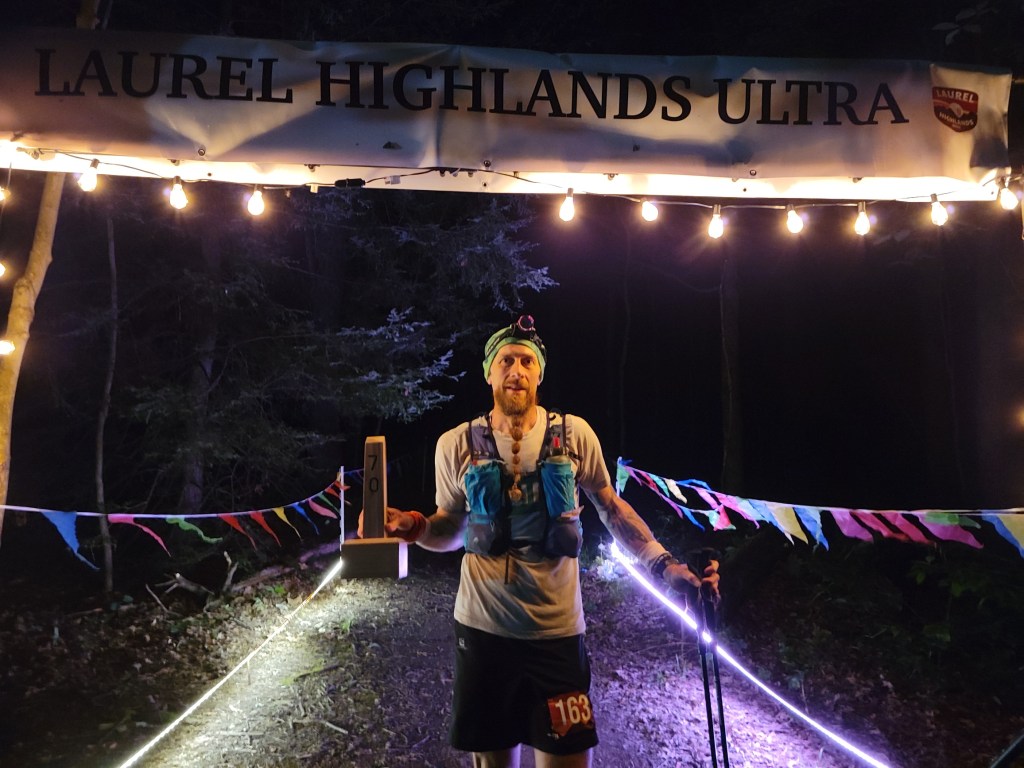
by Andy Styer

I never intended to do these two races the same year, since they take place on back-to-back weekends. The plan was always to just do Laurel Highlands and that’s it. Well, I had my name on the waitlist for Worlds End, just in case I didn’t get into Laurel for some reason. I actually forgot about it, and since I was pretty deep on the list, I never removed myself once I was officially registered for Laurel Highlands. The last 3 weeks before the race I catapulted from 93rd down to single digits. It wasn’t until a week before Worlds End that I actually got in. I had a little help, too, but that’s not for public knowledge : )

So, the real question was, could I actually pull this off ? Worlds End is a course that always had my number. I finished in 2020 @ 18hrs 4 minutes, and in 2021 I DNF’d at mile 35. Laurel Highlands I did in 2019 with a finish time of 17hr 13 minutes. No crew, no pacer. 

For Worlds End, I quickly assembled a team of pacers and crew. I secured a camping spot where my good friend and training buddy Kyle was renting a yurt. The race started off great–I wasn’t trying to kill it, just trying to finish it! All was well until my stomach turned south and my pacers & crew had their hands full with a runner in the “pain cave.” They all had explicit instructions from me to not let me drop unless I broke a leg. They didn’t, in spite of my whining and fits. They kept me going and I was able to finish in 18 hours and 55 minutes. 5 minutes to spare!

At Laurel, this time, I just had my crew of Kim (my partner) and Nathan (my son), who met me at every crew access point. No pacers, but the race went well. Laurel Highlands is a similar course in elevation gain, but it has many more flowing, runnable sections. This race went rather well, and I finished in 17 hours and 52 minutes. 

Andy finishing the Laurel Highlands 70-mile ultra just a week after running Worlds End 100k!

I was rather surprised that I could do these back-to-back. There was little to no recovery coming from hard 70-80 mile training weeks to Worlds End, and then really no recovery time head into Laurel Highlands. I really cherished this feat and the support I got from my family and friends. 

What’s next on the race calendar you say? Nothing,  just rest and having fun on the trails!

Race Report: The Seneca7

by Lisa Domeshek

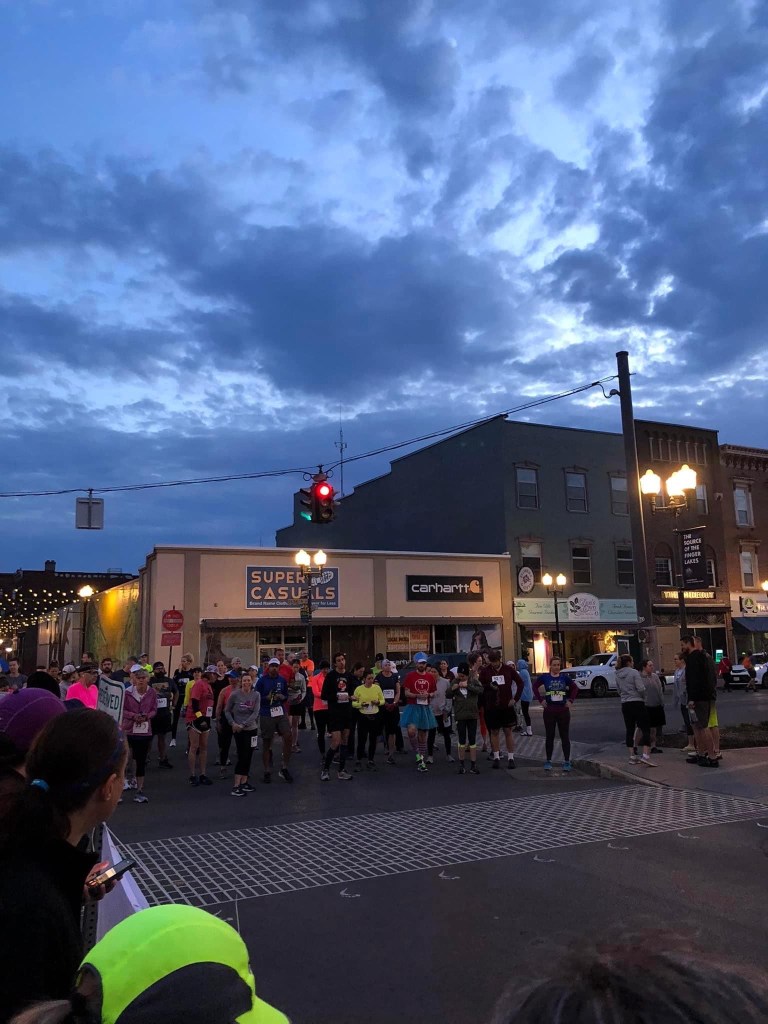
In the early morning hours of Halloween 2019, I sit at my computer, stretching my fingers, preparing myself for the frenzy of the Seneca7 race registration.  The race is known to sell out within minutes, so I have to move quickly if I don’t want to miss out.  True to form, my friend Emily types faster and fortunately secures our spot.  We’re excited and have no idea that we won’t embark on this adventure for two and half long years.

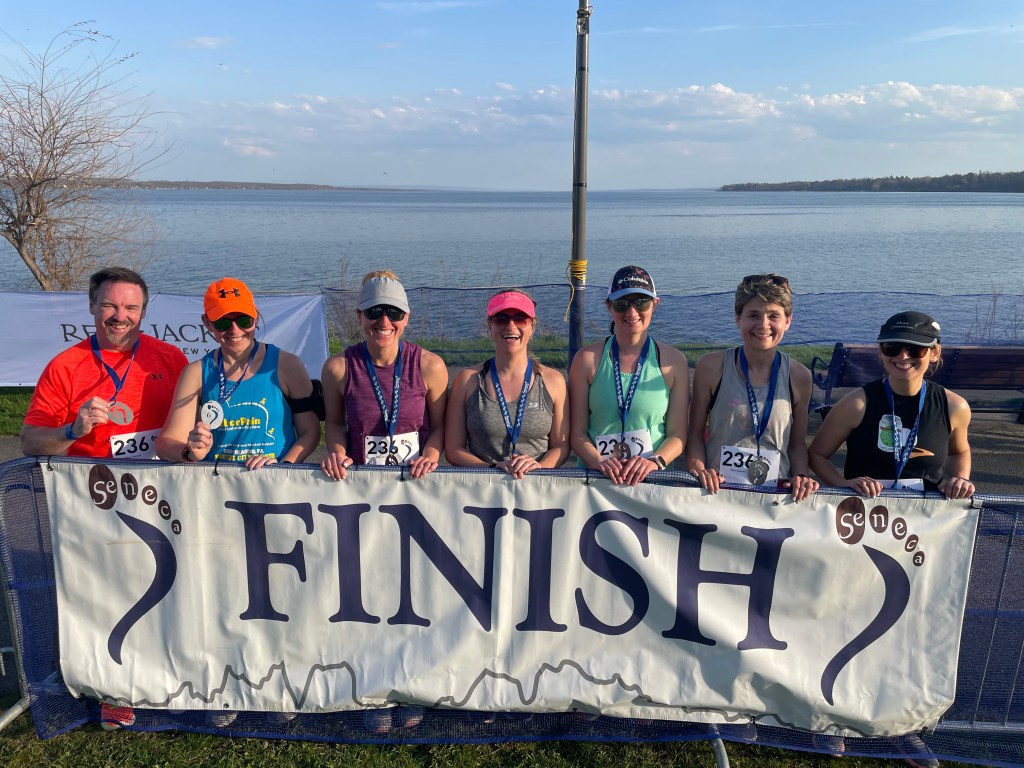
The Seneca7 is an annual relay race held in April that spans 77.7 miles in the Finger Lakes region of New York.  Teams of seven runners complete three separate legs ranging between 2.5 and 6.2 miles on roads surrounding beautiful Seneca Lake.  The format is similar to a road Ragnar Relay with the team riding in a van during off-legs.  The exchange points are often at local wineries and breweries, which the region is known for. There is also an option to form a bike team where you cycle opposed to riding in a van during your non-running legs. This would be quite the challenge as you are self-supported in either case. 

Fellow Pacers Donna and Blair introduced me to the race.  They had been participating for a few years and Donna had already formed a team, so I rounded up six other running friends. (The list of teammates ended up changing so many times before we actually got to run the race!)  We name our team “Pour Choices” and make cute matching hats. We meet several times to plan the logistics, including renting a house and a van, planning what we want to eat, and exploring which wineries we might want to visit after race day. 

It’s now March 2020.  Our grocery lists are ready to go, we requested time off work, and we spent a decent chunk of change. But you know what happens next – everything is canceled.  Our excitement quickly fades to disappointment.

The race offers a virtual option, but we decide not to participate.  We receive the option to forfeit our money, with a portion being donated to charity, with an automatic entry for the following year, avoiding the morning registration frenzy.  2021 comes and the race is once again held virtually, which still isn’t how we want to participate.  However, we still have automatic entry for the following year. 

2022 rolls around and it looks like we are finally going to get to do this! But for various reasons, three of our team members have to back out.  This shouldn’t be too big of an issue though; we have a great local running community, and this race sounds awesome.  Donna’s team is going through something similar and is also looking for teammates.  At this point, the race requires participants to be fully vaccinated.  Also, we need runners who can get away for a weekend, preferably a long one, as the race is on a Sunday and takes the full day, and ughhh Hyner is the same weekend. Donna and I are both scrambling and asking the same pool of runners.  By the beginning of March, we finally have our team together.

We found a house again, but no cute matching hats this time.  My energy for planning and replanning this trip is really starting to wane. Two weeks out, a team member gets injured, which was way worse for her than it was for us. We double-checked but Seneca 7 won’t let us start the race with six runners.  Desperately, we try to secure one more runner and with a stroke of luck we find the perfect fit three days before we must submit our final roster. Game on! 

Our final team includes Karla Reppert, Jackie Snyder, Kate Willis, Jenn Guigley, Emily Trudel, Blair Hogg, and myself. Maybe we could have come up with a much funnier team name, but it’s too late for that now. 

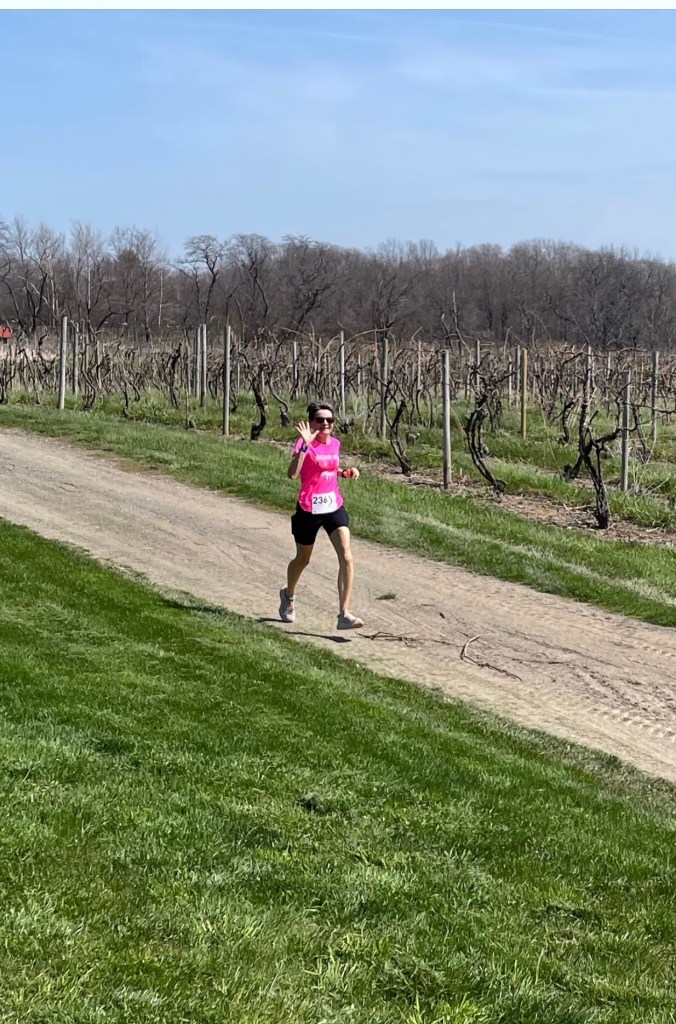
We get ourselves up to Seneca Lake and it’s finally race day with a 6 a.m. start and I am runner #1 — Eeekkk! The teams start in waves, and we are in the first. The race starts at the top of the lake in Geneva and runs counterclockwise around the lake ending back in Geneva.  My first leg is beautiful.  The temperature is in the low 50s, and I get to watch the sun rise over the water while I run 3.8 miles over a few rolling hills. When I finish running, I hand off a slap bracelet to runner #2, Jackie, and get on a shuttle to rejoin my team at the second exchange. Legs 1 and 2 involve a shuttle to help alleviate traffic; after that, you are in the van. 

Our entire team is running well and having a great time. Then it’s time for my second leg. Now I am fully awake and ready to go. My second leg is 3.3 miles, and I am running my heart out. The first mile is straight downhill, and I am passing the very few runners that are ahead of us.  We are all running better than expected. I get to a turn and some lively spectators partying on their porch yell, “Wait for It!!!” and sure enough I round a sharp turn to a very steep uphill. Ughhh — I was not prepared for this, and I don’t want to become “roadkill.” (Teams are tallying their “roadkill”–the number of runners they pass–and it is recorded in the results.)  So straight up I go for a mile, finishing this leg on the flat main road and now it is HOT! The temperature rose to the high 80s with no clouds and a “real feel” of 90. Two years ago, it had snowed right before the race. 

Everyone proceeds to run their second leg just as well, and it’s time for my last leg. I was originally a little nervous about being stuck in a van for such a long time but the day has flown by. Something was always happening.  My last leg is 3.7 miles and feels flat, but is slightly downhill. I am very thankful that I have not been on a bicycle between legs at this point, as it feels so brutally hot. I finish, and it’s finally time for a beer! Blair is our last runner and we all meet up to run the final part of his leg as a team to the finish. Little do we know, he has finally passed the guy in front of him, and he plans on really running it in, so we chase him down, unprepared, which is a little comical. 

Overall, this race was very well organized and a lot of fun. I can see why it sells out so quickly every year. Pour Choices placed 109 out of the 211 teams, at 12:31:17. Not too bad considering that we just wanted an excuse to have fun, drink wine, and visit the Finger Lakes.

Race Report: Hyner 50k

by Jason Karpinski

April 23, 2022

To say my first Hyner 50k experience was unique is an understatement. My day started bright and early around 3:45 a.m. with a shower. Michelle and I left at half past 4 (as planned) with an ETA of 7:27 a.m. All was going smoothly, and my mind was at ease…until my low tire pressure light switched on somewhere in the neighborhood of Minersville. One quick stop at a nearby Sheetz turned quickly to panic when their air pump was out of order, and I was able to put a dent in my tire with little effort. Frantically, I found a nearby Sunoco which was a mere 2.5 miles away. Unfortunately, as many of you may know, Pottsville’s roads are fairly unforgiving. Every bump in the road felt like a cramping hamstring (more of that to come later in the day). After paying $2 to attempt filling my tire, I faced the seemingly daunting task of changing my first flat tire. Luckily the donut was in good shape, and we were quickly back on the road. 

Our ETA was now 8:02.

Did I mention that the race start was scheduled to start at 8:00??

Several deep breaths were needed to calm myself down to a reasonable level. The temptation to hit the gas was overwhelming; however, the desire to arrive safely was even greater. All was well, and I was confident I would be able to start a couple minutes late, even if it meant pleading graciously with RD, Craig Fleming. As our trip progressed, I proceeded to calm further, that is, until we hit a stretch of 45 miles on US-220. Since we had to limit our speed to 50 mph on the donut, we realized the ETA on my GPS app wasn’t accurate, as we saw it tick later and later. I felt my anxiety growing and growing.

By the time we arrived at 9650 Renovo Rd in North Bend, PA, it was nearly 8:30. By now I was significantly less confident I would even be given the chance to start the race. My saving grace was that the 25k started at 9 and there were already designated cut-off times which would force me to switch my race regardless.

Upon scrambling to find the appropriate personnel to get my bib (#1913), I was sent to find my way to the start line and officially start my race day. As the miles ticked away, I traversed the many named trails along the way: Carl’s Way, Humble Hill, Post Draft, Johnson Way, S.O.B., and Huff Run. During my miles I had the fortune of seeing many familiar faces and meeting many others. Luckily, my legs carried me through the miles with general ease until a downhill of what seemed like miles. During this downhill my right hamstring felt like it would either cramp until my heel touched by backside or simply tear in half. Small steps lend relief from danger, and I made it to the bottom. Mile 24 and I saw my car in the distance, with a brand spanking new tire, courtesy of our very own Pagoda Pacer President, Michelle Henry. Relief swept through my mind, and I was greeted by the joyous smiling face of Michelle. 7 miles to go and one more long climb to reach the finish line. Upon finishing, I checked to make sure my time was official (6:20:23), so that the quest for the Black List could continue.

There was one person missing from this race weekend, and this was unfortunately a result of his passing at the top of the first climb during last year’s race. This man was Carl Undercofler, a Hyner legend, and someone I unfortunately never got to meet. His presence was felt by everyone, however, as his face was appropriately plastered on every race bib. Throughout the day I was reminded how awesome the running community is. From volunteers and spectators to fellow runners, my day was filled with smiling faces and words of encouragement. It all culminated in a unique experience which I will never forget, and a race that I would highly recommend to all trail runners.

Race Report: Devil Dog 100-miler

by Lou Donofrio

On December 4th, I raced the Devil Dog 100-miler in Prince William Forest Park, Virginia, having also finished 4th in the race in 2019.  

This year was warm during the day, and I was comfortable running in shorts and a t-shirt. However, racing a trail 100-miler in December meant that most of the race would be in the dark.  Once the sun went behind the hills, I added layers, and ran with a head lamp and a waist light. The added lumens were key to navigating the rooty, leaf-covered single-track trails in the dark.  

I finished 8th overall in 24:21:11, enjoyed another buckle, ate, slept, went to work, and began planning for the next training block.

Happy trails!  

Here’s Mud in Your Eye: Oil Creek 100 Race Report, 2021

by Matt Brophy

Why?

That’s a pretty common–and pretty reasonable–question to be asked if you tell someone you’re going to run a 100-mile race. But it’s not a question that a fellow Pagoda Pacer is likely to ask. In fact, many of my closest friends in the club are the answer to that question. So many runners in this club have a history of not only doing crazy, extreme things, but also then convincing their friends that they, too, should do crazy, extreme things. Why run 100 miles? Because the Pagoda Pacers convinced me I should do it, I could do it, and what the heck was I waiting for? 

Training

The fact that I regularly run with multiple runners who have each finished multiple 100-milers blows my mind, but it also means that I had access to a wealth of advice about how to prepare for this madness. Of course, not everyone agreed, but I was able to cobble together a plan that I thought I could stick with, as long as I didn’t get injured. I would try to average 40-60 miles a week (which I did for nearly 8 months), and throw in a bunch of 50k’s, a couple buzzards, and maybe one 50-miler a couple months before the race. (It ended up being closer to 43.) I eased off once or twice when I felt like I needed extra recovery time, but I was pretty consistent with my mileage and long runs. I also tried to be a little more disciplined about my diet, and mixed in some strength and interval training to try to improve my efficiency. I managed to stay healthy and get my weight under 130 pounds, which was the lowest it had ever been as an adult. (I know that sounds really light, but remember, I’m 5’3”.) 

Added benefit: I was able to fit into that awesome sailor costume for Blues Cruise.

The Race

Originally, I wanted to run the Midstate Massive Ultra, which is a point-to-point race that starts in southern New Hampshire and traverses the entire state of Massachusetts from north to south. But this race conflicted with the wedding of a very old friend that I really didn’t want to miss, so I ended up pivoting to the Oil Creek 100, which was the following weekend. (Steve Vida, whom I had convinced to sign up with me, also graciously pivoted to accommodate my needs). Little did we know we were trading in a cool, dry autumnal weekend in New England for a massive mudfest in western PA.

There were some benefits, though, to switching to Oil Creek. Garry Rarer, who had offered to crew and pace me, knew the course (as well as the race director) well, since it is close to his hometown. So I was able to get some insider knowledge about what I was up against. Also, Oil Creek is a 50k loop that you run three times (plus an additional 8-mile “coming home” loop), so it was much easier, logistically, for my crew. They would just have to shuttle back-and-forth between two access points (Titusville Middle School and “Petroleum Center”) and wait for me to eventually show up. 

The Weather

In the week leading up to the race, I kept checking the forecast. Each time I checked, it looked worse. Chance of showers turned into chance of severe thunderstorms with strong winds. By the time Yuriko and I drove out there, it seemed pretty certain that it was going to rain on-and-off (if not continually) all weekend, and the course was destined to become a muddy mess. Prior to this, I had estimated my odds of finishing as 1-in-2. I told Yuriko, “Now I think it’s more like 1-in-3.”

The night before the race, at our Airbnb, I tried to go to sleep around 8pm, and after lying there for who knows how long, I finally fell asleep.

The alarm woke me up at 3am. I had some breakfast, got dressed, got my gear together, and then put on my headlamp to walk the dogs. It wasn’t raining. Then, just as Yuriko and I got ready to load up the car and make the 30-minute drive to Titusville, the rain started. By the time we got to the middle school, it was coming down pretty steadily. It would continue, with varying intensity, for the next 11 hours.

The First Loop (Start to 31 miles: 5:00am to 12:18pm)

The race started at 5am sharp. 

The first time around the course it really wasn’t that bad. Yes, it was slow and muddy, and there were some slippery parts, especially the switchbacks coming into the first aid station, but it was still fairly runnable. Steve and I ran together for much of the first half of this loop, but I left Aid Station 2 before him, and then ended up running the remainder of that loop by myself. 

Around mile 20, for some reason I felt good, and I started to really think that I was going to be able to do it. But as I got closer to the end of the loop, my stomach started to act up (probably due to those delicious aid-station breakfast burritos), and I wasn’t so sure. I popped out of the woods, hit the pavement, and felt pretty drained. How was I going to do two more loops??

Yuriko was waiting for me as I jogged back into Titusville around 12:15 pm. She had the car parked just off the course. I approached her and said, “Well, we gave it a good shot, but I guess it’s just not my day. I think I’m done.”

For a second, she gave me a look of shock and disbelief, but I couldn’t keep the gag up, and so I quickly told her I was just kidding. “I feel great!” I said, which was not quite true. We laughed, restocked my vest, and I headed out for my second loop.

The Second Loop (31 miles to 62 miles; 12:18pm to 8:54pm)

Steve was not that far behind me–I saw him heading in to Titusville as I was heading back out. (This paved section between Titusville and the trailhead was one of the few breaks from the mud.)

When I hit the trail, it was obvious that the conditions had gotten much worse. There really weren’t many runnable sections on the way to the first aid station. The climbs were frustrating, as my feet would slide back with each step, and the downhills ranged from tricky to treacherous. Sometimes you just had to find a tree to slide towards and hope you could get to it and grab it before you wiped out. 

Eventually I found myself running with a guy from New Jersey who, like me, was making his first attempt at this distance, but unlike me, he was out there with no crew and no pacers. I was worried for him. He was doing all right, but it was going to be a long, long night out there all alone.

Then, as we started to get close to Aid Station 2 (at “Petroleum Center”), the skies miraculously started to clear and out came the sun. Of course, we were still soaked and covered in mud, but it was a huge boost, nevertheless. We felt a little lighter and found ourselves running again, bouncing down the trail to the road.

As we ran down the road towards the aid station, we saw a guy taking our picture with his phone. I assumed it was a race volunteer, but after he moved the phone away from his face, I saw that it was Garry! I hadn’t expected to see him and the rest of the crew (Marsha and Marcus) until I got back to Titusville at the end of loop 2. This was yet another boost to my spirits. 

After I grabbed some food at the aid station, I sat down (for the first time) with the full crew around me. Yuriko restocked my vest; Marsha helped me change my shoes and socks; Garry grabbed more food for me to take on the trail; Marcus…I forget what Marcus did…but I’m sure it was helpful. 

Running is not often a team sport. I wasn’t used to this kind of attention or support, or the feeling, as I headed back out there, that I wasn’t just running for myself. Now I started to think that I had to finish. My team was doing their part; I had to do mine.

About an hour or so after this, I finally hit the 50-mile mark. The sun would be setting soon, and I was just barely halfway done. I still had a long, long way to go. I also started to notice a pain on the left side of my chest. It gradually started to grow more acute, until, in a fit of paranoia, I thought that I might be having a heart attack, even though I otherwise felt pretty good. 

Turns out, my vest was just a little too tight, and the plastic bottle I had been using to squirt maple syrup into my mouth every 30 minutes had bumped into my sternum just hard enough and just often enough to develop a bruise. It was a weird and silly “injury,” but much better than a heart attack. I adjusted my vest, downed some crushed ibuprofen at Aid Station 3, and felt fine as the darkness settled back into the valley.

Running alone in the woods at night is always a little weird, and it’s even weirder when you’re very, very tired. I tried to make up goofy little songs to distract myself. “100 miles / is a long way to go. / If you get stuck in the mud / You can’t call for a tow. / You gotta run all day / And run all night / Then run a little in the morning / To make it come out right.” 

Before I went too, too crazy, I finally made my way back to Titusville. 

The Third Loop (62 miles to 92 miles; 8:54pm to 8:46am)

Once again, my crew was amazing. I was able to quickly change my shirt, chug a 5-Hour-Energy, eat some broth and noodles, get a back-up headlamp and some dry gloves, and then get back out there. Garry was MIA for a moment, but just as I was ready to pull out, he emerged in his running gear, ready to pace me the next 14 miles. 

Having pacers for the final two loops was indispensable. My “friend” from New Jersey who was trying to do this whole thing solo didn’t make it through the long night–like so many of the other 100-mile starters (58 out of 84 did not finish).

It was about 9:15pm as Garry and I headed out to start the third loop, and the rain was back. I told Garry that I had spent so much time staring down into the mud, that I had started to differentiate between three different types. Type 1 Mud was not too bad–squishy and sloppy, but you can run in it. Type 2 Mud was frustrating and destabilizing. It didn’t make you lose control, but you couldn’t get anywhere when you were in it. You wasted energy, and it wore you down. Type 3 Mud was treacherous. It was ankle-deep, and if you encountered it on any kind of a grade, you would just slide and slide until you hit something or could grab something or found yourself face-down in it. (Somehow, I managed to avoid totally wiping out at any point. Each time I did slip and fall, I was able to at least partially catch myself on the way down.)

As we made our way onto the trail, it was clear that by this point, the course was almost entirely Type 2 and Type 3 Mud. I was hopeful there might be more runnable sections on the eastern side of the creek (the second half of the loop), but here on the western side, I was just trying to stay upright and keep my shoes on. As an added challenge, the rain and the cooling temperature brought in some fog, decreasing the visibility afforded by our headlamps.

By the time we slid into Aid Station 1, I could feel big clumps of mud in my shoes, painfully pushing into odd pressure points in the bottom of my feet. Prior to this, my feet had held up remarkably well. But I had to spend a few moments here taking off my shoes and socks and trying to shake out as much mud as possible. Somehow the big clumps of mud had gotten INSIDE my socks. This problem would keep resurfacing for the remainder of the race.

I performed this shoe/sock cleaning seated at a cozy campfire with a handful of volunteers. One of them said, “Damn, your feet are so small,” to which I replied, “Well, they’re actually proportional to my very small legs.” They seemed impressed that I had retained enough of a sense of humor to joke around with them. Apparently some other runners had just been through who did not find them amusing. “How can you possibly run all day and night in this shit without a sense of humor?” I asked.

That won them over. “This guy can stay,” one said.

“I’d love to stay,” I replied. “This campfire is nice and cozy. But if I stay for a minute longer, I might not ever get back up.”

After a slow, frustrating climb in Types 2 and 3 Mud out of the aid station, we eventually found some stretches of trail that were somewhat runnable, and I was happy to find that I could still, at least occasionally, shuffle through the muck at a respectable pace. But it was still a long trek down to Petroleum Center. Garry kept me going, and he also kept me eating. 

“Time for a pierogi, brother?”

He also made a point to celebrate each time I farted or stopped to take a leak. He insisted these were good signs that my body was functioning properly. As we passed the 70-mile mark, it did seem pretty amazing to me that I was still awake and still moving. I had been out there, in the rain and mud, after all, for nearly 20 hours. That was already far longer than anything I had ever done.

“A 100-miler is like going to war,” Garry says. “You train and prepare the best you can, but you have no idea what’s gonna happen once you get out there.” 

We made it to Petroleum Center at 2:10am. 75 miles were behind me. Less than a marathon to go. My crew had miraculously cleaned and dried the shoes and socks I had started the race with, and as I put them on, it felt like a warm embrace from the God of Lost Feet. 

Garry took a break as Marcus set out to pace me the next 16 miles. It was time to finish this 3rd loop. My spirits were high.

It would not last.

Marcus and I began the steep muddy climb out of Petroleum Center. He couldn’t believe the soupy mess he found himself in. “Welcome to my world,” I said.

After that initial climb, I was hoping we would be able to run for awhile. There are some nice, wide trails with gradual downhill grades, overlooking ravines and waterfalls, on that part of the course, and they hadn’t been super-muddy the first couple times through. They had really been quite lovely. I knew this time, in the dark, we wouldn’t have the views, but I was looking forward to the not-so-terrible footing.

By this point, though, even the “good sections” were pretty poor. And in the dark, it was hard to tell just how deep the mud went or what would happen to your foot when it landed. 

My strength, like the course, was also deteriorating. As we hit the 80-mile mark, suddenly everything started to hurt–especially my ankles and knees, stressed for so long by trying to stabilize and balance myself on this slippery terrain. 

“I don’t think I can run anymore,” I told Marcus. “At what point, do you think, will I be too far into this thing to drop?”

“You’re already past that point,” he said. “You only have 20 miles to go.”

“I know what it takes to run 20 miles. I’m in no shape to run a 20-miler right now.”

“Don’t think about it that way.”

“Hypothetically speaking, though, what happens if I do drop? Like at the next aid station?”

“Marsha will slap you in the face. And then she’ll tell the story of slapping you in the face over and over again for years.”

When we did get to that next aid station, I was able to pound more ibuprofen. At first I was afraid about taking more, but then I realized it had been nearly 11 hours since I had been at this aid station and taken my first dose. It would probably be fine. I also got some hot broth in me and some Coke, and I shook more mud out of my shoes.

The volunteer at this aid station–Heather–was the race’s foot care specialist. She had a kind of Biblical generosity and empathy about her. She was, after all, washing and tending to the feet of suffering strangers: a filthy job which she performed like it was a vocation. My feet were amazingly un-blistered, so I didn’t need those skills, but I still somehow felt re-energized by her compassion and insight with regard to what I was feeling. “Hey, I know it hurts, but you’re doing great. I’ll see you at the finish.” 

I also had to ask Marcus for his jacket at this point. I should’ve grabbed my own at Petroleum Center, but I hadn’t felt cold at the time, and I failed to realize how quickly that would happen once I was no longer running. The temperature was down to the mid-40s, and it was still drizzling. I had been shivering when I came into the aid station, but now with the broth in me and Marcus’s jacket on me, I felt a little better. 

I knew, however, that it was going to be a long 8 miles back to Titusville. I was still not able to run at all, and we were covering less than 3 miles an hour. What if Marcus got cold, and I had to give him back his jacket? (Marcus insisted he was not cold, and I kept the jacket. We joked about how we would eulogize him if he ended up dying of hypothermia. “His death was tragic, but it was for the noblest of causes: so Matt Brophy could finish his 100-miler.”)

God bless Marcus. I was a miserable son-of-a-bitch in those slow, cold pre-dawn hours. He kept asking me how I was feeling, and I kept saying things like, “Pretty goddamn miserable still. No need to keep asking.” He could’ve done anything with his weekend, but he chose to march in the mud in the dark with a cranky friend who was pretty terrible company. 

Eventually the sun came up (though it was still cloudy and drizzly), and I could finally take the headlamp off. We were still in the woods, but after another half hour, we hit the pavement, just before 8:00am. 

“Marcus, shall we run?”

I tried, and that lasted for about 90 seconds. Even on the flat pavement, I couldn’t manage more than a fast walk, which wasn’t really fast at all. I also realized that I really needed a bathroom break, and so I hit the first available portajohn. (Actually the first had no TP–of course!–so I had to move on to the next. This was also the first time I ever pooped twice during a single race.)

Garry ran out to meet us and usher us back into race headquarters. It must have been pretty obvious that I was falling apart. 

“You don’t really need anything, right brother?” he asked. “Only eight miles to go. Might as well keep moving and get it done.”

I was shocked. Don’t need anything? There were so many things I needed–clean socks, clean shoes, painkillers, caffeine, food, water, or maybe scrap all that and just give me a place to lie down. But of course Garry was right. Nothing I could do at this aid station was going to make the last loop any less painful. Might as well just get back out there and get it done. But goddamn it, let me sit down for a minute and knock some more mud out of my shoes and socks.

As I came within sight of the rest of my crew, I was struggling to fight back the tears. I really wanted to stop. More than anything. But I knew I couldn’t. No one would let me. Even I wouldn’t let me. I had to go back out there. And it was gonna hurt. Every fucking step was gonna hurt. 

This was the only time I was unable to keep a positive attitude when meeting with my crew. I knew I was going back out there, but I wasn’t happy about it. I was fragile, and I couldn’t hide it. 

Someone told me that Steve had dropped several hours ago. I had been thinking he would eventually catch up to me, since I had been walking–very slowly–for the past 12 miles. Learning this fact made me feel sad, but also jealous. (No one wants to DNF, but at least he was done with this shit.) 

Luckily, I still had plenty of time. I had less than 8 miles to go, and it wasn’t even 9:00am yet. The cut-off was 1:00pm. There was no way it would take me over 4 hours to go 8 miles, right?

The “Going Home” Loop (92 miles to 100 miles; 8:46am to 11:14am)

The final loop didn’t turn out to be as bad as I thought it would be. The rain finally stopped, and Garry and I even saw some blue sky peeking through as we hiked back along the bike path to the trailhead. It’s amazing how a little bit of sunlight can help a body that’s ready to shut down somehow come back to life. 

Right before we jumped back into the mud, we caught up to a woman who seemed a little lost. (How anyone could get lost on this course is beyond me–it was excessively well-marked.) 

She asked us if we knew where the final loop went. We told her it started out the same as the regular loop, but there was a left turn (clearly marked) that we would make a little over 3 miles into it. She was skeptical. 

“Are you sure?”

We were sure. Still, she didn’t seem to believe us. She told us to go ahead, and she tentatively followed. I told her we would shout back when we got to the turn. She also let slip that this was her second 100-miler in as many weeks. A good reminder to myself that while I may dabble in masochism, at least I’m not (yet) fully addicted to it. 

Whether it was the sunlight, the proximity to the finish, or just a desire to stay ahead of the woman we just passed, I found myself hiking a little faster and even managing brief bursts of running where the mud seemed relatively stable. 

We hit the left turn a few minutes before 10:00am, shouted back that we were indeed on course, and made our way down to creek-level. Since this section of the course was only run by the 100-milers (not the runners competing in the 50k or 100k events), and only by the 100-milers who made it all the way to the end, it was not nearly as trampled as the rest of the course. In fact, I would later learn that I was only about the 15th runner to make this descent.

After crossing a nifty (and slightly bouncy) pedestrian bridge across the creek, Garry and I began climbing up the other side. This was a TOUGH climb–about 400 feet in a little over half a mile–no harder than climbing up to the Mt Penn Firetower from my house, but during my 97th mile, it was pretty daunting. I also knew, however, that it was the LAST climb. Getting back up to that ridge that I had just been on a couple hours ago with Marcus felt pretty great. 

At that point, it was just another mile and a half of mud–mostly downhill–and another mile and a half of pavement back to Titusville and the finish.

I would have loved to have run more of those final sections–especially the final mile–but my legs (and joints) were just toast. The reality that I was actually going to finish this thing started to set in, and I could feel myself getting emotional.

Garry told me it was fine to walk back towards the finish, but that I’d need to run over the bridge and the last 200 yards. I thought running the last 20 feet would be good enough. 

“Nah, brother, they really want to see you running as you make that final turn.”

Well all right then. 

There were, of course, tears at the end, and hugs for every member of my amazing crew. I was so grateful for their support, and I was so grateful to be able to finally stop. 

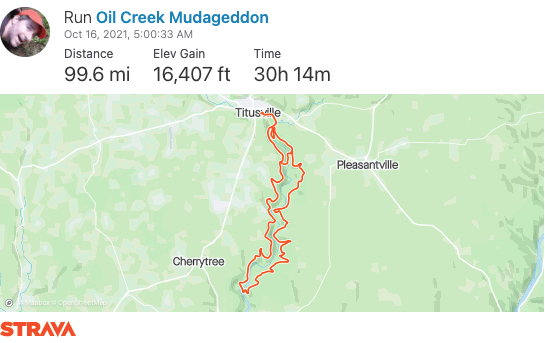
I ended up finishing 16th overall, with an official time of 30 hours and 14 minutes. There were 26 official finishers, and 58 DNFs. It was the highest DNF rate in Oil Creek history. 

The Aftermath

After a $10 shower at Titusville Middle School, and a heartfelt goodbye with Marsha, Garry, and Marcus, Yuriko and I went out to lunch with Steve, Michelle, and Jason to debrief over pierogi, crab cakes, and beer. After a few jokes, bites, and stories, I felt unable to eat anymore or speak in complete sentences. It was time to pick up the dogs (from a local kennel) and head back to the Airbnb. 

I expected to instantaneously crash once we got back, but instead, my body started freaking out. Not only was there soreness everywhere (and some throbbing pain in my ankles), but I seemed to be developing a fever. I was shivering and achy, but also hot to the touch. I took some more ibuprofen, kept drinking water, and eventually my fever came down enough for me to pass out, probably around 6pm.

I woke up in the middle of the night soaked in my own sweat. I found a sleeping bag we had packed, put that on the bed, got into it, and fell asleep. Eventually I woke up sweating again, and then slept for a few more hours on top of the sleeping bag.

Finally it was 6:00am, Monday morning, and I got up. I had slept for about 12 hours; I was really hungry; and my left ankle still really hurt. But otherwise, I felt ok. I drove out to a nearby “General Store” to get us some coffee. We walked the dogs, packed up the car, and drove back to Reading.

On the way home, I told Yuriko that I was “retiring” from ultra-running. That’s probably not true, but I’m definitely going to take a break. And even if I run more ultras some day, I can’t imagine ever doing another 100. That was some crazy shit. Don’t get me wrong– I’m glad I did it–but never again. 

But then again, who knows what bad decisions “future me” might make?

North Half Fjallakofans (Iceland) 25k Race Report

August 26, 2021

by Michael Whalen

Our Iceland trip was originally planned to compete in the Road Marathon on Reykjavik. As in most places, the race, sports expo, and city celebrations were postponed. The initial six days of the trip were filled with hiking, casual running and viewing icebergs, waterfalls, and a volcano. I really was not disappointed that the marathon was cancelled.

On day six we arrived at a quaint fishing town that appeared to have some trails on a really big mountain range. After lunch, I decided to walk the town, find a trailhead and determine where I could run 12ish miles and get some elevation. I easily found a trail that appeared to be an out-and-back with some good climb included.  I phoned my sister and we decided to meet at the Segal Brewpub. The 3 of us arrived from different directions at the same time. There was a fair amount of people outside and there was a line to what looked like the hostess stand. Here is where things became fun.

We walked up to Helga and my sister noted she had a laptop and race bibs! We looked at each other and Jodi knew what my next steps would be. I quickly learned that tomorrow morning there was a 25k and also a 50k race, starting in the next town, 30 minutes away. I stayed in line and asked Helga for more info. “The race is sold out, and we are not allowing day-of registration.” Using a bit of persuasion and some begging, pleading, and appearance of sadness, I managed to convince her to give me her email address so I could follow up with her after all the bibs were picked up. I sent an email, basically adding all the info that you would put onto a race application, my Strava name, and screen shots from the week’s runs/hikes. I am guessing that my begging, knowing what info to send, and my Blues Cruise hat and Labor Pain 55-mile vest sealed the deal. In 16 hours, I would be running a 25K!!!!  Since she was not equipped for payment, Helga reported there would not be a fee for my entry. (I did slip her some cash on race day.) 

My excitement was off the charts. Let’s drink some local beers and figure out the next steps. I found the race photographer (from California) and his “crew”, including a road marathoner, doing her first trail race. I was able to arrange a ride to the starting line with the marathoner. Jordan’s wife was not racing but helped mark the course and reported that there is a varied terrain and snow on the course! I was also told to expect a few big climbs. A few more beers and something kind of healthy for dinner, back to the hotel to do race prep. Hokas, shorts, race shirts….check. Running vest, water bottles, gels, fuel….NOPE! I have never been less prepared for a race.

Race day: The race started at 11:00 a.m., allowing time to sleep in, enjoy 2 coffees and a good breakfast. I was in the lobby early and the ride to the start was uneventful. There was a hotel at the starting line and it appeared that all rooms were booked by runners. Why was registration at the finish line and not here? Karma for me! The music was playing, a few professional-looking podcasters were recording, and 50K runners were passing through. My pre-race happiness was kicking in. We lined up and a very long pre-race announcement was delivered. I was hoping that it was more nothing important, since the speech was not in English! 

We lined up and off we went! The initial 1.5 miles were on street and the marathoner I met was at a 6 min/mile pace. I settled in before the first hill. No need for poles for the rolling initial 3 miles. Then things became real. I found a few English-speaking runners and learned there was only 1 aid station and it would have drinks and maybe a piece of candy.

For the next 3 hours, I ran in mud, crossed 12 streams, had wind that blew us sideways, 3 snow fields (one that was on a slope that caused many runners to slide about 100 yards off course), moss bogs that were like running on a soft mattress, several 4 foot straight up climbs, fields with no markings (often not knowing if we were on course), a river, and a few climbs that were similar to the Leg Destroyer. I passed the marathoner at mile 6 and she was struggling with the PA-style rocks but having fun. I made good progress on the uphills (thank you Leki) and was feeling pretty good for the duration of the race.

Not knowing the course had the disadvantage of not knowing how hard to push for an 18 mile race. I went at it aggressively and after the mile 13 river crossing noted that the course was dirt road and street into the finish line. Time for the after burners for a 8:02, 8:42, 9:15 final 3 miles.  

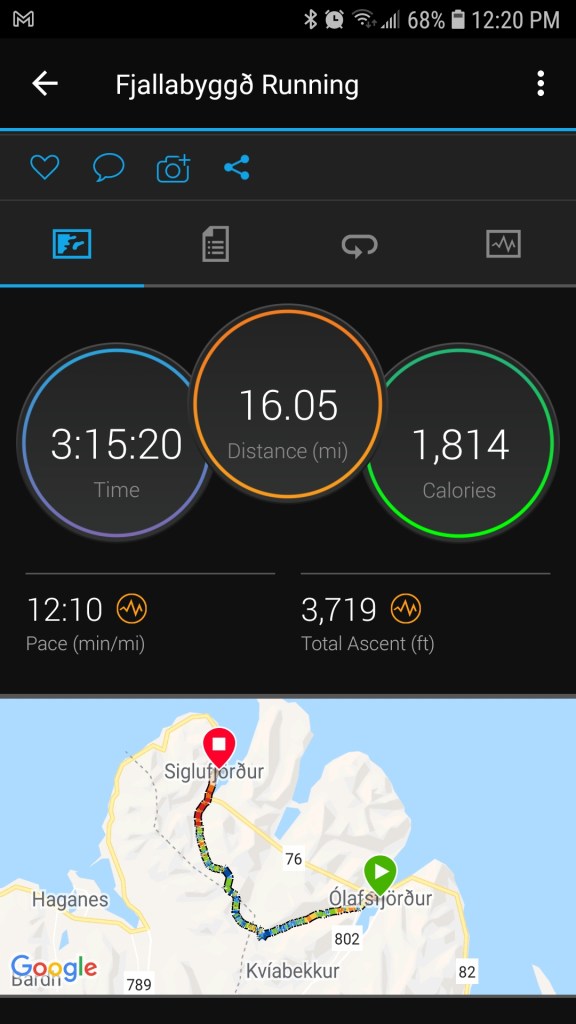
The town was packed with cheering fans: a Norwegian style band was playing and the excitement was better than awesome! 3 hours and 15 minutes for the 16 miles with 3,719 of ascent. 36th place and 2nd in my Age Group.

In closing I am grateful for having the Karma of finding this race, being permitted to compete, having enough gear to “wing it”, finishing uninjured and not lost in the August snow and using the great advice from my fellow Pagoda Pacers to figure this one out.   Bless Bless! (Icelandic for goodbye)

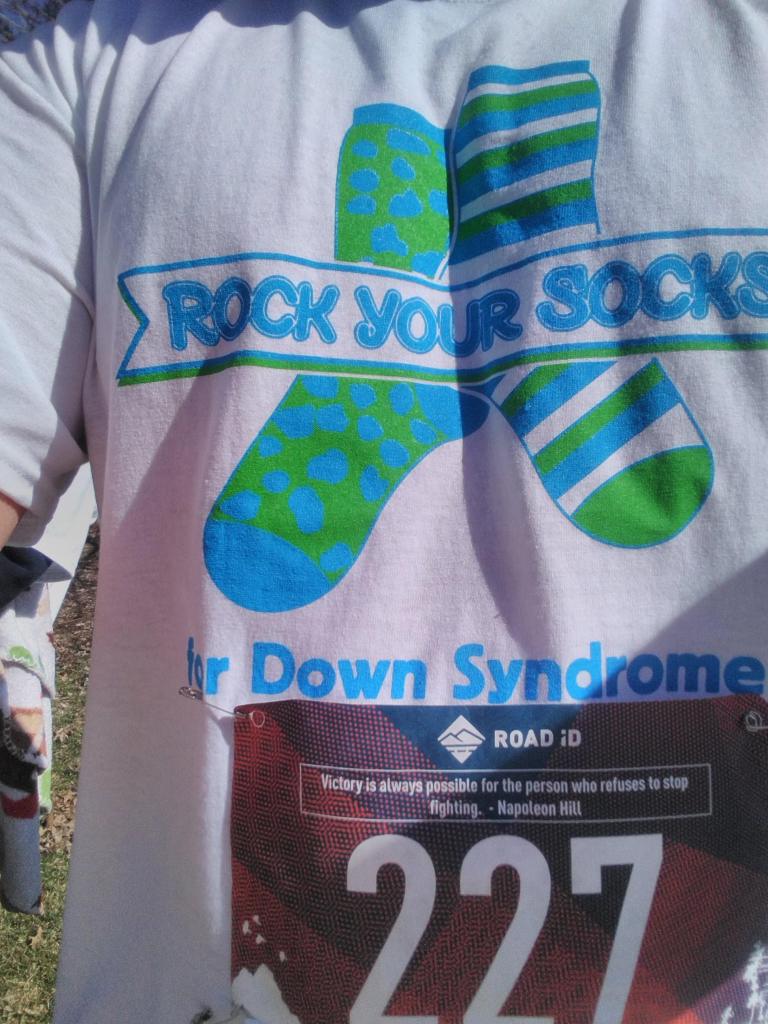
Race Report: Rock Your Socks 5k

by Robert Stichter

I ran this race on March 20th at Cairns University. The track club held its annual Rock Your Socks 5k. This was a benefit for World Down Syndrome Day. My son, Hunter, who will be 1 on April 6th, has Down’s. This was his first race! (Well, I pushed him in a running stroller.) The race was just a little longer than a 5K: 3.21 miles. 3/21 is World Down Syndrome Day. “3.21” also signifies the Trisomy 21. Trisomy 21 is the most common chromosomal anomaly in humans, affecting about 5,000 babies born each year and more than 350,000 people in the United States. If you look at the shape of the chromosomes of Trisomy 21, it looks like a pair of mismatched socks (hence, “Rock Your Socks”). So each runner was asked to wear a pair of mismatched socks, which Hunter and I did. We completed the 3.21 rolling hills race in 36 minutes. Not too bad for having fun, pushing a stroller, and oh yeah–taking a time-out to change a diaper. LOL!