
by Andrea Thrush
It’s that time of the year where we will start seeing increasing temperatures and humidity. Regardless of current level of fitness, it is important to make sure we stay hydrated. This article is set up in sections, so it is easy for you to find the subtopics that apply the most to you and your situation/needs.
The basics
Did you know:
- about 2/3 of your body weight is water (National Institutes of Health, 2023).
- One study found a link between dehydration and the development of chronic diseases in middle-aged people (National Institutes of Health, 2023).
Proper hydration affects…
- most of our body’s day-to-day functions (USATF, 2015)
- athletic performance (USATF, 2015)
- our overall health (CDC, 2024)
- our athletic recovery (United States Olympic Committee Sports Dietitians, 2011).
- our mood (CDC, 2024).
- our ability to think clearly (CDC, 2024).
- our chances of developing kidney stones and constipation (CDC, 2024)
- The USATF (2015) claims that just a 1% decrease in hydration levels can lead up to a 6% reduced athletic performance.
How much water?
According to the CDC and the USATF, plain water (versus sports/electrolyte drinks) is all that is needed to maintain hydration levels, as long as we are eating normal meals.
The “eight cups a day” rule many of us learned is not accurate, because the amount any one of us needs can vary based on many factors, such as the weather for that day, what we eat, our weight, if we are traveling by plane, etc. Try to ensure you drink smaller amounts throughout the day (CDC), and increase the amount on hot, humid, or dry days, as well as on windy days (USATF, 2015).
The USATF (and other sources) claim that the “pee test” is the easiest way to see what our hydration status is (look at the color of your pee). They also note that some medications and B-complex vitamins can make your pee darker than it might normally be.
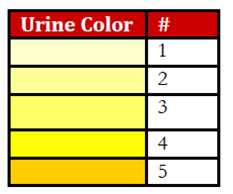
Image source: United States Olympic Committee Sports Dietitians. (2011). The goal is to be between 1 and 3.
Dangers: While drinking too little water can be dangerous, drinking too much at once can be dangerous as well (USATF, 2015). The CDC recommends that no one drink more than 48 oz (1½ quarts) per hour to avoid medical issues from drinking too much of ANY fluids (this includes sports drinks). This is due to salt levels in our blood becoming too low (CDC).
Drinking alcohol can lead to dehydration, and increase the chances of heat illness for 24 hours after drinking it (CDC) See below for information on heat stroke and heat exhaustion, which can happen at anytime (not just while exercising).
Signs of dehydration (according to the United States Olympic Committee Sports Dietitians):
- Lack of concentration
- Early fatigue
- High perceived exertion in training
- Trouble tolerating heat
- Delayed recovery
- Muscle cramps
- Loss of body weight exceeding 3% of normal body weight (post-exercise)
Electrolytes: (calcium, potassium, phosphorus, chloride, magnesium, etc.)
We lose sodium and potassium the most when we sweat, so if you are exercising for long amounts of time, or in heat, consider replenishing electrolytes. Otherwise, it is likely not needed, and water should suffice (CDC, 2015).
You can play around and make your own:
Plain coconut water has sodium and potassium, as well as carbohydrates (check nutrition labels for varying amounts between brands).
OR
2 cups water, 2t sugar, 1/8 t salt, and a splash of fruit juice (Larson, 2016).
Take action: tips for increasing water intake
- Carry a reusable water bottle with you (CDC, 2026).
- Freeze water in freezer-safe bottles for ice-cold water all day (CDC, 2026).
- Choose water over sugary drinks (CDC, 2026).
- Opt for water when eating out (CDC, 2026).
- Serve water during meals (CDC, 2026).
- Add a wedge of lime or lemon to your water (CDC, 2026).
- Try healthier beverage options, such as black coffee, plain tea, sparkling water (my son adds a touch of 100% juice to his), or flavored water (CDC, 2026).
- You can set alarms as reminders (Mayo Clinic, 2023).
- You can use a bottle that tracks your intake, so you can track your progress (Mayo Clinic, 2023). You could always just use paper and pencil to track progress, or an app. Some Garmin models have a feature where you can add your water intake on the screen of the watch. If getting enough water is a struggle, tracking progress can be motivating.
- Make drinking water a part of your routine. This can include times such as when you first wake up, when you eat your meals, brush your teeth, or even when you use the bathroom (Mayo Clinic, 2023).
- Make it social – challenge a friend, coworker, family member, etc. (Mayo Clinic, 2023).
Heat related illnesses
Heat Exhaustion
This happens when the body loses too much water and salt (CDC, 2026). According to the CDC, symptoms include:
- Headache
- Nausea
- Dizziness
- Weakness
- Irritability
- Thirst
- Heavy sweating
- Elevated body temperature
- Decreased urine output
Heat Stroke
This is worse than heat exhaustion, and the body can no longer control its temperature (CDC, 2026). According to the CDC, symptoms include:
- Confusion, altered mental status, slurred speech
- Loss of consciousness (coma)
- Hot, dry skin or profuse sweating
- Seizures
- Very high body temperature
- Fatal if treatment delayed
If you or someone you are with experience either heat exhaustion or heat stroke, call 911. Get them out of the heat and into shade or AC. Help them drink some water, and try to help cool their body down by removing unnecessary clothing/layers (including shoes and socks), wetting their skin and clothes, and get air circulating if possible.
References/for more information:
(1) Centers for Disease Control. (n.d.) Heat Stress: Hydration. https://www.cdc.gov/niosh/mining/UserFiles/works/products/training/keepingcool/2017-126_hydration.pdf
(2) United States Track and Field. (2015). Track & Field Coaching Essentials: USA Track & Field Level 1 Coach Education Manual.
(3) United States Olympic Committee Sports Dietitians. (2011). Sports Nutrition – Fluid for Athletes. (provided by USATF Level 1 Coaching Credential program).
(4) US Centers for Disease Control and Prevention. (2026). Heat-related Illnesses. https://www.cdc.gov/niosh/heat-stress/about/illnesses.html
(5) US Centers for Disease Control and Prevention. (2024). Fast Facts: Data on Water Consumption. https://www.cdc.gov/nutrition/php/data-research/fast-facts-water-consumption.html
(6) Larson, A. (2016). Fuel For Sport: The Basics (Exercise Science Collection).
(7) Centers for Disease Control and Prevention. (2026). About Water and Healthier Drinks. https://www.cdc.gov/healthy-weight-growth/water-healthy-drinks/index.html
(8) National Institutes of Health. (2023). Hydrating for Health: Why Drinking Water Is So Important. https://newsinhealth.nih.gov/2023/05/hydrating-health
(9) Mayo Clinic. (2023). Tips for drinking more water. https://www.mayoclinichealthsystem.org/hometown-health/speaking-of-health/tips-for-drinking-more-water

