
by Tania Salaneck
Anyone that has been in the ultrarunning scene for a while knows about the Barkley Marathons and Laz. So few runners get to experience this test, Laz created the Fall Classic as a way for more mortal runners to partake in the Barkley experience in a smaller dose. I’m not sure at what point I learned about this race, but last year, I decided to put myself in the lottery on a whim. I can’t take away from myself what I’ve accomplished over the past 15 years of ultrarunning, but I really didn’t think I had any business doing this race. While I have determination and a crazy amount of endurance, I’m not particularly fast. For whatever reason, Laz decided I should be running this race, so I started planning.
My summer had some solid training, getting into elevation in Blowing Rock and then Creede, pacing Maggie at Eastern States 100, and running 50k with Niki at Labor Pain. I was trained, if nothing else. We drove part way and then finished our drive to Oliver Springs on Friday, heading right to packet pickup. I felt an immense imposter syndrome as I listened to Laz talk about how the mountains formed and how Barkley came to be. We ate dinner at packet pickup but skipped the football game where the runners are welcomed into the community. I needed time to prep, and I wanted to try and get a decent amount of sleep.
With our bibs, we were given a compass, a whistle, and a cloth map of this year’s course. The course has minimal markings, and I watched groups of people gathering to scrutinize the map and discuss plans. I chose to forego that exercise. We got to our cabin, and I started pulling my gear together for the next morning. I knew from research that the briars on the powerline climb called “Rat Jaw” could be brutal, and runners had a multitude of approaches to handle this. I chose a pair of what hashers call “shiggy socks,” soccer shin guards, and a heavy-duty pair of work gloves. I had a ton of snacks packed in my hydration vest, and a cheap kid’s pedometer watch, since GPS is forbidden. Trekking poles are also not allowed, but runners can utilize any sticks they scrounge up on course.
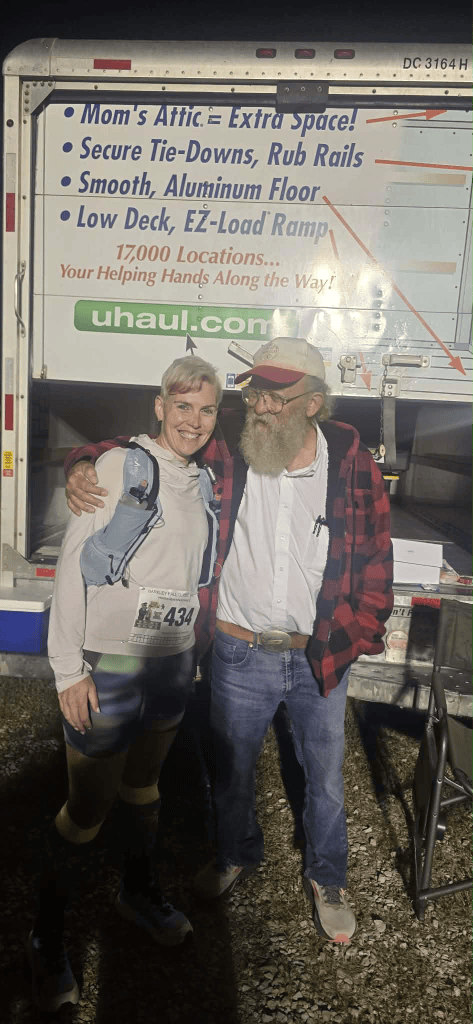
The morning of the race, I made some coffee and had some pastry for breakfast—no skimping on calories! It took us about 15 minutes to get to Brushy Mountain State Penitentiary, where the race started. At this point, I felt oddly calm and really just wanted to start already. I got to talk to Laz for a minute prior to the ceremonial lighting of the cigarette, and we were off. Jeff went to his assigned volunteer assignment at aid station 3 while I tackled the first hill.
The first cutoff was an hour into the race, and Laz said if you couldn’t make it to the top of the road climb in an hour, you had no business pressing on. It was a steady climb, but nothing that felt horrible. We dipped into the woods onto some single track at the top, and I got into a rhythm. Then we hit Upper Rat Jaw. Immediately, there were multiple lines driving uphill directly under the power lines. Leaving that course would result in disqualification. There were heavy briars and other types of brush, in addition to the steep, loose dirt paths. In some sections, there were cables that could be grabbed, but having the gloves allowed even the briars to serve as something to grab to assist with getting up the hill. Since the course was just staying under the power lines, people were taking all kinds of different routes, crisscrossing under the wires. I was no exception, and I pressed up an alternate route with another woman, working our way under the briars in almost an army crawl at points.
We hit a wall of rock and had to wait our turns to get through the narrow channel cut through. Once we finally hit the top of the climb, we were scratched and bloody, but nothing really felt terrible. There was a fire tower just above Rat Jaw, and I got my first letter punched on my bib, which is one of the ways they can track that you’ve done the whole course. Then it was time to cruise some downhill. This is my happy place, the more technical, the better. I passed maybe 20 people on this section, and I had a few other runners comment that they didn’t know how I was moving like that on such technical trail. I explained that I live in Rocksylvania, and one guy told me it really showed.
Unfortunately, this section was also quite cambered, and I was still wearing those thick socks. I felt my foot sliding weirdly but didn’t think anything of it right away. Then I started feeling right heel pain. I decided to try and take care of my feet sooner than later, so they wouldn’t get any worse. I had a shear injury on the heel from all of that movement, which was essentially a very deep blister that covered the entire heel. I tried to drain it unsuccessfully and settled for throwing some kt tape on with my normal socks. I was still moving but had to slow on the descents. Every time my foot would land on a rock, my ankle would immediately try to roll, likely as a way of trying to protect my heel involuntarily.
I continued to push forward, and I really started pushing uphill, since I could control my foot placement a bit more reliably. Lots of people were using sticks on the climb, but I used the hands-on upper thighs approach. I passed maybe 25 more people in this section. I heard a very distinct whoop in the distance and knew I was approaching AS 3, where Jeff was. One of the volunteers told me I was the 48th woman. It was a quick stop for me, just topping off water and mixing two more bottles of electrolytes. With the temp in the 90s, this was a necessity. After I left the aid station, I pulled out the fabric map from my pack and realized that I could wring it out. This section was an old jeep road, and I did my best to keep running, despite again trying to turn my ankle on multiple occasions. A handful of people passed me in this section. There was another AS in this section, and John Kelly punched my bib before I continued on.
This jeep trail led back to the iconic yellow gate, and a photographer was there—I can’t wait to see that picture. I continued onto a section of road, back to AS 2/5. The cutoff was 4:20, and I got there a bit before 2. I asked one of the volunteers how I was doing on time, and he told me it was going to be tough to hit the final cutoff at the decision point in time. I had to be there by 5:20. I started climbing another brutal trail called Chimney Tops Trail and decided that I would make one more attempt at trying to fix my heel if I had any chance for the full “50k.” I very quickly realized it was a futile effort and pushed on. This is when it really hit me how well prepared I was. I don’t consider myself a strong climber, but I again passed many people and never saw them again.
Chimney Top climbed forever, and eventually I was back at the fire tower, which I now had to climb. Once down, I got another punch and now had about 20 minutes to make it down Rat Jaw…the whole way down. I think this was one of the few times where I wish I’d been going up. Down was brutal. I had my gloves still with me, and I used all the plant life I could along the way to break me from freefalling. I ended up in a pack with a few guys. The one caught his foot in the cable and did a split. Not long after, he said he needed to sit as we passed him. I thought he needed to gather himself after the fall, but I could hear him start prolifically vomiting behind me. This sped me up a little bit.
Descending all the way down Rat Jaw took way longer than I had hoped, and I watched the cutoff pass before I reached the decision point. I had passed the guys I was with and kept pushing. Then I heard someone behind me again and realized my vomiting companion was rallying. I let him blow past me. The last bit of descent was very steep, and I needed to crabwalk down a few feet before reaching the last gully as I approached the decision point. I fell forward hard but caught myself with both hands on the uphill without missing a beat. The spectators cheered for that, and I approached Laz. At this point, my time was stopped, but I was able to cross the finish line below for the “marathon” finish (most people calculated this as about 28-29 miles and ~9500 feet of vert). Jeff was waiting, they announced my name, and I earned my dog tag.
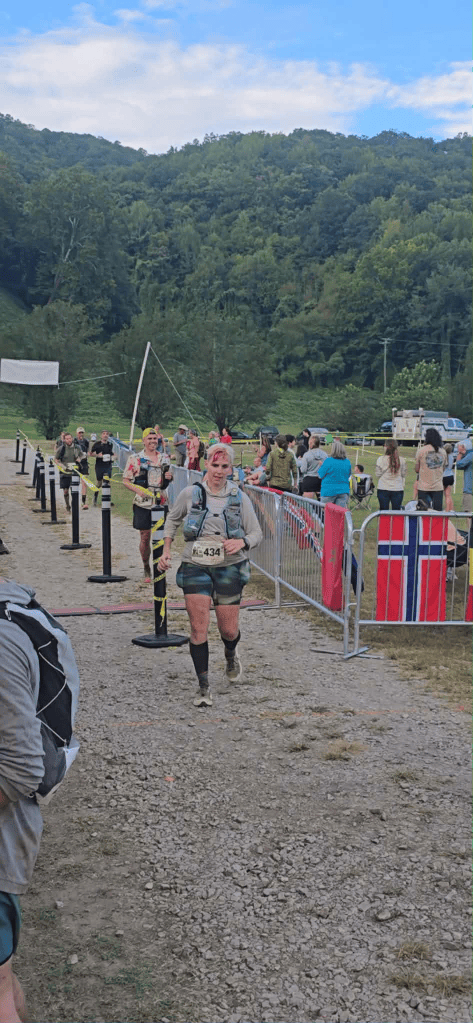
As soon as I crossed the finish, my foot decided I no longer wanted to be able to walk easily. We grabbed some food, sat on the grass, drank an amazingly cold soda, and I finally exhaled. This was a tough race, but I never felt like I was doing something beyond my ability. One thing I noticed, and I wish was not the case, was how few women were out there. We made up 22% of the field. I really thought about this after the race. I had the idea that I had no business being here, but I take that back. I have every right to push myself into these spaces. I really hope my fellow women runners take this to heart. You belong in these races, too.

