Race Report: Crazy Mountain 100—Still Crazy After All These Miles

by Meghan Cook

I love the Pennsylvania mountains, but how could they begin to prepare you for the fresh hell of Montana’s magnificent peaks? Cody Harris, as a Montana State alumnus, has a deep fondness for the state and the courage (or masochism) needed to sign up for a truly crazy event. The Crazy Mountain 100 webpage warns potential runners, “This is sure to be the craziest race you have ever attempted,” and boasts elevation gain of 23,000 ft, not to mention a base elevation of at least 5,000 ft above sea level. (I live at about 300 ft, for reference.)

We woke up at 3 a.m. on Friday and loaded up the rental SUV with coolers, food, sleeping bags, and gear, knowing that it would be a long time before we saw the Airbnb again. Cody was stressed, his watch telling him, “Body Battery: 6%” (Sidenote—what happens when it reaches 0%?) The only solution to prerace nerves is to start running, and Cody joined the crowd of crazies to hear a blessing from a member of the local Apsaalooke (Crow) tribe as the sun rose. The race kicked off at 6:00 a.m., with a few runners bursting out of the portajohn to join the herd as it took off for the mountains.
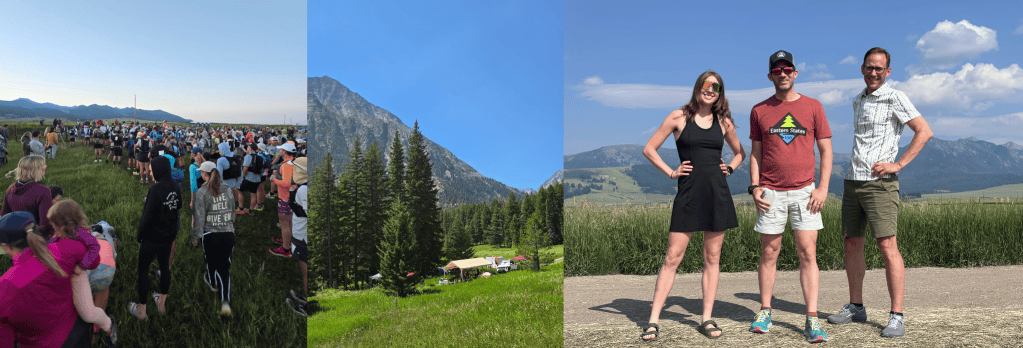
Then, the crew’s job began. Brittni drove us to the first crewable aid station, Ibex. Each aid station was accessible only via remote forest roads, and the parking situation was inevitably sketchy. At Ibex, Brittni drove up to a guy wearing a bright pink hat. 

Brittni: Can we park down there? 

Pink Hat Guy: No.

Brittni: Don’t you think you should stand back there to direct people?

Pink Hat Guy: I don’t work here.

You could almost hear him thinking, So fuck off, Karen. In retrospect, we rolled right past a sign that read, “No crew vehicles past this point.” We saw Pink Hat Guy repeatedly over the course of the race, and at the finish line Steve apologized to him over some foamy beer. Brittni remains unapologetic (well, he shouldn’t have been standing there). 

My first time crewing at an aid station, I waited among happy dogs, ringing cowbells, and the smell of pancakes. Family and friends lined up along the trail, many wearing custom T-shirts of their runner. Cody arrived a little ahead of schedule, and Brittni offered him a variety of foods, while I ran to replenish his water bottles and ice bandanna. Cody spilled some mashed potatoes on himself, Brittni wiped it off with her clothing, and sent him on his way. 

Cody left the first aid station in good spirits, but when we saw him again at mile 43, he had blisters on both feet. The top of the mountain was far wetter than we predicted (the surrounding landscape is arid) and mixed with a brutal climb, his feet were in bad shape. Brittni patched up his feet and put on fresh shoes and socks, and we sent him back up the mountain with Steve, knowing he was in for a world of pain. 

Brittni and I wouldn’t see the boys again till after midnight, so we tried to catch some sleep at the next aid station. Brittni blew up a sleeping pad for me, and I stretched out behind the car, sleeping bag zipped over my head against the bugs. I woke up in darkness to my alarm 90 minutes later. There was a dog yipping nearby, and Brittni assured me that he’d been going for a long time. On our hike to the aid station, we saw headlamps twinkling down the mountain, some alone, others in pairs. 

The descent from Sunlight Peak changed things. Steve originally planned to pace Cody through the night, but traversing the loose rock cliff face, in the dark, for half a mile of sheer terror, and at least a 20% chance of death (though not a bad way to go), Steve didn’t want to slow Cody down. Cody, at this point, was beyond caring much if he lived or died and wasn’t bothered by the potential free fall into shadow. Brittni switched Cody’s shoes and socks again, loaded up an extra battery, and Cody headed out solo into the night. 

I slept again on the drive to Forest Lake, the final crewable aide station before the finish line. We parked right next to the trail, and I kept sleeping until Brittni woke me up.

“Cody’s two miles away!”

I scrambled to get changed, eat something, and gear up. As Cody walked and then jogged out of the driveway and onto the trail, I could have skipped. Finally! Getting to do what I’d been training for. Steve told me and Brittni about the beauty up in the mountains, what we could only imagine from the aid stations below. Alpine lakes surrounded by mountains and snow-melt waterfalls. For the first ten miles or so, Cody seemed spirited. He was conversant and ran whenever the trail leveled out. We had one main climb that took us out of tree cover to fields of wildflowers under stunning blue skies. The trail unraveled before us, utterly exposed. Not a good thing for Cody’s burnt legs, and watching runners climb distant hills sucked the truth out of my assurances that “This is the last climb!”
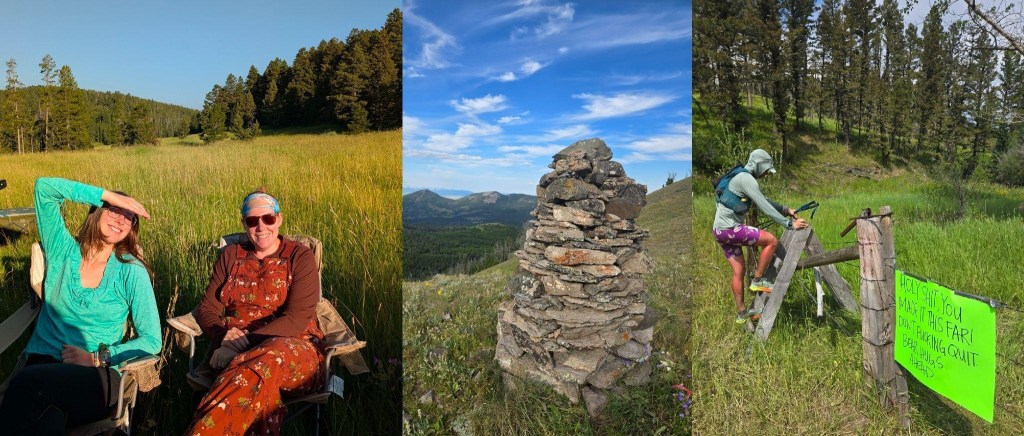
The last seven miles were the worst. Though finished with the mountains, the pastures spread infinitely before us, the farm where we would finish a mere speck in the distance. But even though his hip flexors and feet hurt, he kept taking painful steps forward. The body is incredibly resilient, and Cody went from a sleep-deprived start, to uncertain whether he’d be able to finish with blisters and 60 more miles to go, to sprinting across the finish line so fast I couldn’t get my phone out in time to take a picture. 

If you run into Cody and notice his shirt doesn’t fit right, it’s because he’s got a belt buckle the size of a dinner plate. Brittni ran the operation so smoothly that Cody’s only job was to keep moving forward and consume whatever she gave him. Crewing wasn’t easy, with driving two hours between aid stations with terrible parking.
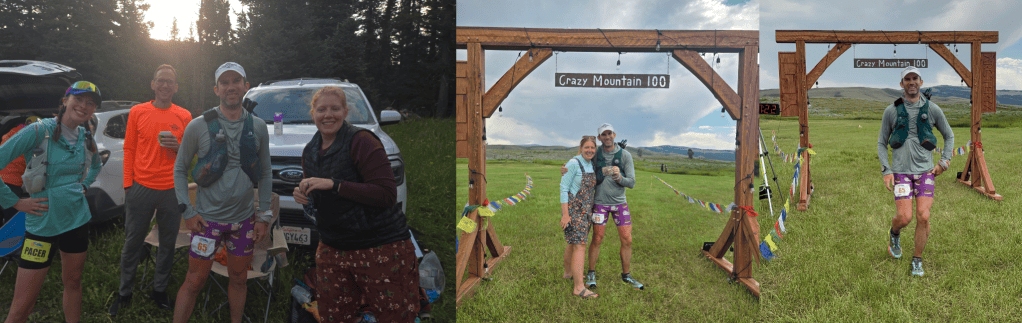
I’m so lucky I got the chance to tag along on this adventure (thanks, Matt, for taking a conflicting trip to Nova Scotia). The Pagoda Pacers sustain a culture that makes the crazy seem possible, and if you see me running far beyond that amount recommended to maintain a healthy lifestyle, blame the bad influence of my friends. 

What’s Cody doing next? Well, he might try to beat his 5k PR from high school, or raise the difficulty of running 100 miles by going unassisted. Whatever his goal, Cody is absolutely crazy enough to achieve it.

World’s End 100K: Successfully Run Like There’s No Tomorrow

by Cody Harris

For me, World’s End 100k was not a race I really had on my bucket list.  Heck, when I signed up for it, I did not even think of it as my “A” race for this year.  World’s End was simply a means to qualify for the Western States lottery.  However, after training for a few weeks and reviewing the terrain and challenge of the course, World’s End 100k became my “A” race, and boy am I proud that I completed it!

My training started in the bleak days of January, and it was the first time I gave myself 6 months to train for a race. I spent a lot of time running hills and rocky trails at Mount Penn, trying to mimic what I would see at World’s End. It was a huge dedication of time, but it also gave me a sense of confidence as I stepped to the start line, and I felt I had built the ability to not only run the race, but also run it well. 

The race starts in the dark, and for the first few minutes everyone runs along an asphalt road in a sea of bobbing headlamps. My wife was at the start line, and I could hear her yelling for me as we turned away from the start area and headed up the road.

I was told about the slow conga line everyone gets trapped in heading into the first climb. I did my best to find a position where I could keep a steady pace as we all worked our way up the hill. While we were climbing, a runner behind me kicked a rock loose and I could hear it crack as it hit boulder after boulder on its tumble down the mountain side. At this point it hit me that none of my runs on Berks County’s rockiest trails could prepare me for what World’s End had in store. 

After a second rocky climb, we made our way up the Loyalsock Trail and arrived at the first aid station. From here the trail leveled out slightly, and I had to remind myself to take it easy, conserve my energy, and keep my heart rate down. If I couldn’t do that in the flatter section between High Rock and Sones Pond, there would be no way to do it later in the race. I ran through a tight tunnel of trees as I approached Sones Pond. I could hear people, but couldn’t see anyone until I popped out of the woods, and there was a whole crowd waiting, which was slightly disorienting.  Brittni met me at Sones Pond with my first food drop: super salty mashed potatoes and gummy bears. 

Leaving Sones Pond, I made a wrong turn on the Link Trail and was directed back by two fellow runners. I was able to return the favor when they missed a switchback a few miles later. 

From there, we did another big climb to get to Devil’s Garden, and then started our descent into the World’s End aid station where I refueled on more gummy bears and potato chips. The trail headed back up to Canyon Vista, and while the distance between the World’s End aid station and Canyon Vista is short, only 3 miles, it involved one of the steepest climbs of the race. I took extra snacks with me from Canyon Vista because I knew it would be a very long stretch until I saw my crew again. 

The miles ticked by with a creek crossing and some short climbs and descents that were too steep to be called rolling hills, but were still dwarfed by what was to come. After the Coal Mine aid station, I came to an overlook and saw the deep gully that stood between me and High Knob, the next aid station. The view was spectacular, but I had been warned that the next 8 miles were some of the most difficult and hottest of the race, and I wanted to make it to High Knob with plenty of energy left for the second half of the race. 

The High Knob aid station was packed with crews, with everyone cheering on the runners as we came through. It was especially exciting to see fellow Pagoda Pacers and get updates on my friends who were also running that day. The vista at High Knob is breathtaking, but as I looked at the horizon all I could think about was that I was currently standing on top of a mountain and the next few miles would take me all the way to the valley below. I started on the very long descent out of High Knob, which really taxed my quads. The next ascent was the hardest of the entire race. It is not the steepest, but it is unrelenting, long, and punishing. Eventually I came to Dry Run aid station, where I refilled my water and saw my crew, but forgot to pick up other food. I didn’t think this would be an issue; I could pick up some food at the next aid station. However, I had forgotten the next aid station was water only which was both a physical and mental setback at that point in the race. My stomach was also starting to turn against me, and even though I was out of snacks, I was worried about my ability to eat more food once I saw my crew again. 

I finally came into Brunnerdale aid station, where I picked up Steve, who would pace me for the rest of the race. My spirits perked up again; I now had a running buddy, a pack full of salty potatoes and sugar, and I knew there were only 2 more significant climbs left! Steve kept me accountable, helping me to move at a faster pace on the descents and runnable sections than I would have if I were alone. 

We hit the last aid station, Fern Rock, and there were only 6 miles to go and about 90 minutes of day light left. I was supposed to get my headlamp but forgot to pick it up and turned out of the aid station headed towards the trail. I knew I had a few miles of flat, runnable terrain, and one last legendary downhill between me and the finish line.

On the last descent, I went full send. I jokingly told Steve he didn’t have to keep up with me, and promptly threw myself down the hill. Steve did keep up with me though, and we turned into the parking lot. As I came through the parking lot, I saw the banner “Run Like There’s No Tomorrow” ahead of me, and the finish line. My first goal was to finish the race; my second was to finish in the daylight, and I crossed the finish line in 14 hours and 51 minutes, meeting both my goals.

Looking back I could not have asked for a better day.  My race played out the way I wanted it too, and I am confident I achieved my best time for the day.  I cannot say the race was perfect, but I believe that is as close as it can be.  For once I left a race not thinking about what I need to do differently next year.  I just kept thinking about wearing the cool belt buckle I had earned.

Before I finish, I would like to thank my wife for the support she provided during the months of training, and the day of the race.  Brittni’s willingness to drive through the woods to feed me salty mash potatoes and gummy bears made all the difference.  And I also need to thank Steve Vida for taking time out of his weekend to pace me. It was such a mental boost knowing that at mile 50 I had someone joining me for the finish.